Anguilla Travel Guide
Welcome to the taste2travel Anguilla Travel Guide!
Date Visited: April 2015
Introduction
As other Caribbean islands succumb to rabid consumerism, commercialism and development, tiny Anguilla has chosen to remain a quiet, charming, serene up-market playground for wealthier, more discerning tourists.
Unlike neighbouring St. Martin, you will not find brash casinos, cruise ship terminals nor shopping malls here. Instead, you will find a small island (26-km long and 4.8-km wide), which is ringed by stunning powdery-white sandy beaches and turquoise waters.
The island was once part of a Federation with St. Kitts and Nevis but is today a British overseas territory.
Location
Anguilla is a flat, low-lying slab of raised coral and limestone seabed which is located a short distance across the Anguilla Channel from St. Martin. The most popular way of reaching Anguilla is via the frequent ferry service, which connects the island to St. Martin (see the ‘Getting There‘ section below for more details).
History
Like neigbouring islands, the original inhabitants of Anguilla were native Arawak Indians who migrated in dug-out canoes from present day Venezuela thousands of years ago. Eventually, they were replaced by the fiercer Carib Indians.

Shoal Bay East Beach is just one of many stunning beaches on Anguilla.
Christopher Columbus sailed past Anguilla on his second voyage to the Americas in 1493 but never landed. The Spaniards named the island ‘Anguila‘, which means Eel, due to its long eel-like shape. The English anglicised the name to Anguilla.
The first Europeans to settle on the island were English settlers who arrived from St. Kitts in the year 1650. In the preceding years, numerous battles were waged between the French and the British for control of the island. However, the British always managed to maintain control.

Anguilla Flag
The British attempted to develop Anguilla into a plantation-based economy by importing African slaves. Unfortunately, the island’s soil and climate were unfavourable and the plantations were largely unsuccessful. Today, 90% of the population of 13,500 is comprised mostly of the descendants of former slaves.

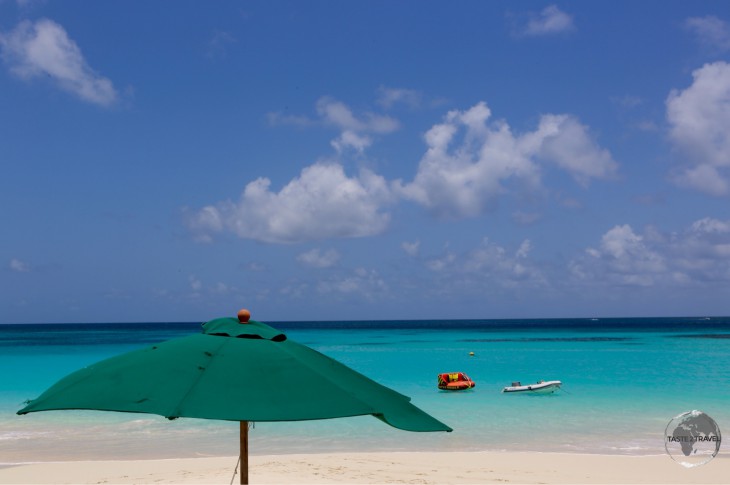
Shoal Bay East Beach is one of the main swimming beaches on pristine Anguilla.
In 1871, the British forced Anguilla into a Federation with St. Kitts. The capital of the Federation was located in Basseterre (currently the capital of St. Kitts). In 1882, the island of Nevis was forced into the Federation. At no time was the Federation popular. Hence, all three islands petitioned for direct and separate rule. During this time, the affairs of Anguilla were managed from St. Kitts. During the 1960’s, two referendums were held whereby the population voted almost entirely to separate from the Federation.
Anguilla was eventually allowed to secede from the Federation thereby receiving its first constitution in 1976. However, it was not until 1980 that Anguilla was formally disassociated from the Federation (at which point it became a separate British dependency).
Today, Anguilla is an up-market tourist destination with the industry being one of the mainstays of the economy.
Sightseeing
The Valley

St Gerard’s Catholic Church, The Valley, Anguilla.
The island’s capital (and also it’s largest city), The Valley (population: 1,067), is a nondescript provincial town that is located in the centre of the island.
The Valley has little history and few examples of colonial architecture due to the relocation of Anguilla’s administration to Basseterre (St. Kitts) in 1825. The town became the capital in 1980 after the island was formally separated from the Federation with St. Kitts and Nevis.
The town is small and compact, there are only a couple of sites which can be seen in half an hour.
- Wallblake House – located at Cross Roads, this plantation house was built in 1787 and is now owned by the Catholic Church who use it to house the parish priest.
- St. Gerard’s Catholic Church – located next door to Wallblake house, this church has an interesting facade decorated with pebbles, stones, cement, wood and tiles.

St Gerard’s Roman Catholic Church is one of the few sights in The Valley, the capital of Anguilla.
If you are hungry or in need of a caffeine fix while you’re in The Valley, I highly recommend Valley Bistro. It is located at Government Corner which is a short walk from Wallblake house. The menu features both French and British cuisine. A good choice for breakfast, lunch or dinner.
Next door to the bistro is the Stone Cellar Art Gallery, which showcases works from local artists.
Around the Island
On Anguilla, there are 30 amazing beaches to explore. If your perception of Paradise is miles of white powdery sand, lapped by warm crystal clear turquoise waters, then this island is close to Heaven.
You can drive around the island in under 2 hours without stopping. However, you should plan to make plenty of stops to enjoy time at the many beautiful beaches. The best beaches are located along the northern coast and here you will find most of the accommodation and dining options.
East End Village
For those who wish to gain an understanding of the island, it’s people, culture and history your first stop should be at the Heritage Collection. Located in the tiny settlement of East End Village, this is the best museum on the island.
This small museum is crammed full of everything to do with Anguilla (including a collection of postage stamps). The museum is the life-long labour of love of Mr. Colville Petty, who has amassed a huge collection of items relating to Anguilla and has arranged them in topical sections. The engaging Mr Petty is not only the owner but also the curator and an enthusiastic guide. Depending on your level of interest you could spend an hour or two here.
Mead’s Bay
If you are in search of lots of white powdery sand, crystal clear, turquoise water with few people then Mead’s Bay is the beach for you. Located on the north-west coast, it is one of the best beaches in the Caribbean.
If you are hungry, you can refuel at the amazing Blanchards Beach Shack – see the ‘Eating Out‘ section below for more details.

Mead’s Bay Beach, Anguilla.
Shoal Bay East
On an island that boasts one amazing beach after another, Shoal Bay East is my pick as the best beach…. A stunning sweep of fine, white powdery sand, lapped by calm, turquoise water. The beach is located on the north-east coast and is never crowded.

Shoal Bay East Beach is one of the main swimming beaches on Anguilla.
Rendezvous Bay
Another stunning beach located on the south-west coast offering more white powdery sand and calm turquoise waters.

Palm trees on Rendezvous Bay, Anguilla.
Accommodation
There is a range of accommodation options catering for all budgets but the island has a reputation as an up-market tourist destination and as such most of the options come with a high-end price tag. Despite it’s reputation you can find rooms for under $100 per night on sites such as booking.com
For those on a tight budget neighbouring St. Martin offers cheaper accommodation options and the frequent ferry service allows visitors to visit Anguilla on day trips.
Eating Out
The cuisine of Anguilla has been influenced by the cuisines of Africa, Britain and France. As with other Anglo-Caribbean islands, Callalloo soup (made from a green leaf introduced from Africa) is a popular starter.
Seafood is abundant and is featured on most menus. However this small, arid island is not suited to raising livestock so most meat (and other produce) is imported.

Blanchards Beach Shack
On an island catering to wealthy tourists, there is no shortage of fine dining options, but it is easy to find more reasonably priced options.
One such option is Blanchards Beach Shack (BBS), located on the beach at Mead’s Bay. BBS offers fantastic, tasty food at reasonable prices and is a local favourite for lunch. Their tacos, jerk chicken sandwiches and lobster rolls are especially popular. After lunch you can roll into the turquoise waters of Mead’s Bay.
Visa Requirements
Some nationalities require visas for Anguilla – check your visa requirements prior to arrival.
Getting There
By Air
The Clayton J. Lloyd International Airport is a small airport located a short drive from The Valley and the beautiful white sand beaches.
The following airlines provide international connections:
- Air Sunshine – flies to/ from Dominica–Douglas-Charles, St. Thomas, San Juan, Sint Maarten
- Anguilla Air Services – flies to/ from St. Barthelemy, St. Maarten
- Seaborne Airlines – flies to/ from San Juan
- Tradewind Aviation – flies to/ from San Juan
- Trans Anguilla Airways – flies to/ from Nevis, St. Barthelemy, St. Eustatius, St. Kitts, St. Maarten, Tortola, Virgin Gorda
By Sea

The Anguilla ferry docked at Marigot (St. Martin)
The most popular way to reach the island is via the frequent ferry service which connects Blowing Point (Anguilla) with Marigot (Saint Martin).
The service runs every 45 minutes, with the crossing taking 25-minutes. You need to clear customs and immigration at both docks. Currently schedules and fares are posted on the Anguilla Tourist Board website.
Charter services can also be booked from Blowing Point to Princess Juliana Airport (Dutch St. Maarten).
Getting Around

The license plate on my Anguilla rental car.
There is no public transport on Anguilla. The best option for exploring the island is to rent a car, which you can do at the airport or at the Blowing Point ferry terminal.
I used Andy’s Auto Rentals, which I would recommend. Andy offers competitive rates and goes the extra mile to provide you with good service.
Like other Anglo-Caribbean islands, the government raises money from tourists by requiring all drivers to purchase a temporary drivers permit – this can be purchased through the rental agencies.
Driving is on the left-hand side of the road. You could drive a circuit around the island in a couple of hours. Thanks to British subsidies the roads are in better condition compared to other Caribbean islands.
Taxi’s are available and charge based on a fixed tariff schedule.
That’s the end of my Anguilla Travel Guide.
Safe Travels!
Darren
Follow me on Instagram:
Further Reading
Other travel reports from the Caribbean region include:
Anguilla Travel Guide Anguilla Travel Guide Anguilla Travel Guide Anguilla Travel Guide Anguilla Travel Guide