Tag - Azerbaijan

Nakhchivan Photo Gallery

Stormy skies, over the turquoise-coloured domes, of the Heydar Mosque in Nakhchivan City.

Nakhchivan Photo Gallery

This is a Nakhchivan Photo Gallery.

To read about this destination, please refer to my Nakhchivan Travel Guide.


All images are copyright! If you wish to purchase any images for commercial use, please contact me via the Contact page.


About taste2travel!

Hi!

My name is Darren McLean, and I’m the the owner of taste2travel. Welcome!

I’ve been travelling the world for 38 years and, 193 of 193 UN countries, 247 of 251 countries and dependent territories, and 7 continents later, I’m still on the road.

Taste2travel offers travel information for destinations around the world, specialising in those that are remote and seldom visited. I hope you enjoy my content!

Ever since I was a child, I have been obsessed with the idea of travel. I started planning my first overseas trip at the age of 19 and departed Australia soon after my 20th birthday. Many years later, I’m still on the road.

In 2016, I decided to document and share my journeys and photography with a wider audience and so, taste2travel.com was born.

My aim is to create useful, usable travel guides/ reports on destinations I have visited. My reports are very comprehensive and detailed as I believe more information is better than less. They are best suited to those planning a journey to a particular destination.

Many of the destinations featured on my website are far off the regular beaten tourist trail. Often, these countries are hidden gems which remain undiscovered, mostly because they are remote and difficult to reach. I enjoy exploring and showcasing these ‘off-the-radar’ destinations, which will, hopefully, inspire others to plan their own adventure to a far-flung corner of the planet.

I’m also a fan of travel trivia and if you are too, you’ll find plenty of travel quizzes on the site.

Photography has always been a passion and all the photos appearing in these galleries were taken by me.

If you have any questions or queries, please contact me via the contact page.

Safe travels!

Darren


Nakhchivan Travel Guide

Nakhchivan Cover Photo


Nakhchivan Travel Guide

This is a Nakhchivan Travel Guide from taste2travel.com

Date Visited: March 2026

Introduction

Welcome to my Nakhchivan Travel Guide – your companion to exploring one of the most unique and lesser-known regions of Azerbaijan and indeed the Caucasus region.

Stormy skies, over the turquoise-coloured domes, of the Heydar Mosque in Nakhchivan City.

Stormy skies, over the turquoise-coloured domes, of the Heydar Mosque in Nakhchivan City.

Nestled between Armenia, Iran, and Turkey, Nakhchivan is a land of dramatic mountains, ancient monuments, and deep-rooted traditions.

Nakhchivan city is the capital of the Nakhchivan Autonomous Region.

Nakhchivan city is the capital of the Nakhchivan Autonomous Region.

From the ancient sights of Nakhchivan city, including Noah’s Mausoleum, to the mystical landscapes of Alinja Castle, the region offers a journey through centuries of history and culture.

Often referred to as the land of Noah, Nakhchivan city serves as the capital of the Nakhchivan Autonomous Republic, an exclave of Azerbaijan.

Blossoms, and Noah's Mausoleum, in Nakhchivan city.

Blossoms, and Noah’s Mausoleum, in Nakhchivan city.

Whether you’re drawn by its Silk Road heritage, natural beauty, or authentic local experiences, this guide will help you uncover the hidden treasures of Nakhchivan and make the most of your visit.

Nakhchivan is a small but fascinating corner of Azerbaijan, set apart from the rest of the country and rich in history, landscapes, and tradition.

The newly constructed Heydar Mosque is the largest mosque in Nakhchivan.

The newly constructed Heydar Mosque is the largest mosque in Nakhchivan.

Framed by rugged mountains and dry plains, the region is known for ancient mausoleums and legends that link it to the story of Noah.

Quiet, authentic, and largely untouched by mass tourism, Nakhchivan offers travellers a glimpse into a lesser-known crossroads of the Caucasus where culture, nature, and history meet.

The ultimate step-exercise workout awaits in Nakhchivan - the 1,500 stone-step climb to Alinja Castle.

The ultimate step-exercise workout awaits in Nakhchivan – the 1,500 stone-step climb to Alinja Castle.

Nakhchivan is a hidden gem waiting to be discovered.

Whether you are drawn by its architectural wonders or its serene natural beauty, a visit to this historic region promises a truly memorable experience.

Location

Nakhchivan, Azerbaijan

Nakhchivan is an autonomous region of Azerbaijan located in the South Caucasus.

It is separated from the rest of Azerbaijan by a strip of Armenian territory, making it an exclave.

Nakhchivan is an exclave of Azerbaijan, bordered by Armenia, Iran and Turkey.

Nakhchivan is an exclave of Azerbaijan, bordered by Armenia, Iran and Turkey.

The region borders Armenia to the east and north, Iran to the south and southwest, and Turkey to the northwest.

The land border between Turkey and Nakhchivan is very short, measuring just 17 kilometres (11 miles) in length.

Despite its brevity, this is Azerbaijan’s only border with Turkey and serves as a vital strategic connection.

Positioned along historic trade routes near the Aras River valley, Nakhchivan sits at a natural crossroads between the Caucasus, Anatolia, and the Middle East.

Nakhchivan City is spread over the foothills of the Zangezur Mountains, at an altitude of 873 m (2,864 ft) above sea level.

Nakhchivan City is spread over the foothills of the Zangezur Mountains, at an altitude of 873 m (2,864 ft) above sea level.

Geographically, Nakhchivan is nestled in the foothills of the Zangezur Mountains, providing a dramatic backdrop of rugged peaks.

The Zangezur Mountains are a rugged and dramatic mountain range in the South Caucasus, forming part of the larger Lesser Caucasus system.

They run, for roughly 130 km (80 miles), mainly along the border between southern Armenia and southwestern Azerbaijan, particularly near Azerbaijan’s exclave of Nakhchivan.

Nakhchivan experiences a dry continental climate, characterised by hot summers and cold winters, which contributes to its unique flora and distinct landscapes.

People

A friendly butcher in rural Nakhchivan who served me a delicious lunch of roast chicken.

A friendly butcher in rural Nakhchivan who served me a delicious lunch of roast chicken.

Predominantly ethnic Azerbaijanis, the friendly folks of Nakhchivan are warm, welcoming and inviting.

Daily customs are shaped by a mix of Turkic heritage, Islamic traditions, and local practices passed down through generations.

value family ties, respect for elders, and community life strong sense of identity, hospitality, and deep connection to tradition.

Life in Nakhchivan centres around family ties and community life with a strong sense of identity, hospitality, and deep connection to tradition.

It was a pleasure to be able to spend time with the Azeri’s of Nakhchivan.

With a capacity of 5,000 worshippers, the modern Heydar Mosque is the largest mosque in Nakhchivan.

With a capacity of 5,000 worshippers, the modern Heydar Mosque is the largest mosque in Nakhchivan.

In terms of religion, Nakhchivan is overwhelmingly Muslim, primarily adhering to the Shia branch, with a smaller Sunni population.

As a deeply conservative and historic region, often called a “Capital of Islamic Culture,” it is culturally and ethnically linked to Azerbaijan’s mostly secular-practicing Muslim population.

Flag

The flag of Azerbaijan.

The flag of Azerbaijan.

Nakhchivan does not have a unique, official regional flag separate from the national level.

According to its Constitution, the official flag of the Nakhchivan is the national flag of the Republic of Azerbaijan.

The flag of Azerbaijan consists of three horizontal bands of light blue, red, and green which mean:

  • Light Blue: symbolises Turkic Multi-nationalism, a movement which was started during the Ottoman empire.
  • Red: a symbol for the ongoing development of Azerbaijani culture.
  • Green: a symbol of Islam, the pre-dominate religion of the country.

In the centre of the flag is a white crescent moon, another Islamic symbol, and an eight-pointed star which relates to the eight letters in the word “Azerbaijan” as written in Arabic.

A gigantic Azerbaijan flag flying in downtown Baku.

A gigantic Azerbaijan flag flying in downtown Baku.

Now that you know a little about the flag of Azerbaijan, you have the answer to at least one of the questions, which you’ll find in my ‘Crescent Flags of the World‘ travel quiz. Good Luck!

Unofficial Regional Flag

An unofficial Nakhchivan flag which was designed in the 1990's.

An unofficial Nakhchivan flag which was designed in the 1990’s.

While Nakhichivan does not have an official regional flag, during pro-Azeri independence rallies in 1990, a flag was designed in which the green stripe and white star and crescent of the Azeri flag was replaced by yellow and the ratio of the stripes was altered.

Although this was an unofficial variant of the Azeri flag, it resulted in widespread reports of a “Nakhichevan” flag.

Currency

As a part of Azerbaijan, the currency of Nakhchivan is the Azerbaijani Manat.

As a part of Azerbaijan, the currency of Nakhchivan is the Azerbaijani Manat.

As a part of Azerbaijan, the currency of Nakhchivan is the Azerbaijani Manat, which trades under the international currency code of AZN.

The term Manat is derived from Moneta, the Roman Goddess of Memory – from which the word Money is derived.

Manat banknotes, which were designed by Robert Kalina – the same Austrian artist who designed the Euro banknotes – are issued in denominations of 1, 5, 10, 20, 50, 100, and 200 manat, alongside 1, 3, 5, 10, 20, and 50 qapik coins.

A 500-manat commemorative note also exists. 

The currency is denoted by a specially designed symbol – – which was also designed by Robert Kalina.

It is a rounded, lowercase Latin letter “m” resembling a clockwise-rotated Euro sign (€).

Exchange Rates

Current exchange rates (March 2026) include:

Credit Cards

While credit cards are accepted in major hotels, supermarkets, and some restaurants in the city centre, cash is king elsewhere.

You will definitely need cash for taxis, small shops, and the local bazaar.

ATMs

ATMs are available in downtown Nakhchivan but not in rural towns.

Costs

Travel costs in Azerbaijan are generally moderate to affordable, especially compared with Western Europe.

Your total spending depends heavily on your travel style (budget vs. luxury), but here’s a clear, realistic breakdown:

  • Budget traveller: about $40–60 per day
  • Mid-range traveller: about $70–120 per day
  • Luxury traveller: $180+ per day

Sightseeing

Home to 95,000 souls, Nakhchivan City is the capital of the region of the same name.

Home to 95,000 souls, Nakhchivan City is the capital of the region of the same name.

Nakhchivan city is renowned for its deep historical roots, dating back millennia.

According to popular tradition, the city was founded by Noah after the Great Flood, adding a layer of mystical allure to its heritage.

Nakhchivan is a hidden gem waiting to be discovered.

A view of the Heydar Mosque in Nakhchivan City.

A view of the Heydar Mosque in Nakhchivan City.

I stayed for 3 nights which was not long enough and would recommend a stay in Nakhchivan of 6-7 days in order to cover the many sights outside the city.

There are many stones in Nakhchivan which were left unturned by me – these will be covered in a future trip.

Alinja Castle

A highlight of Nakhchivan, Alinja Castle is a dramatic mountaintop fortress often called the “Machu Picchu of Azerbaijan”.

A highlight of Nakhchivan, Alinja Castle is a dramatic mountaintop fortress often called the “Machu Picchu of Azerbaijan”.

A highlight of Nakhchivan, Alinja Castle is a dramatic mountaintop fortress often called the “Machu Picchu of Azerbaijan” because of its steep terraces and commanding views.

Even this lounge lizard was able to haul himself up the 1,500 stone steps to take in the amazing view.

Even this lounge lizard was able to haul himself up the 1,500 stone steps to take in the amazing view.

Alinja Castle is a spectacular mountain fortress combining natural geography with human engineering, famous for its near-impregnable design and its legendary resistance against powerful invaders.

The red line shows the approximate path of the stone stairway which leads up to Alinja Castle.

The red line shows the approximate path of the stone stairway which leads up to Alinja Castle.

The castle sits atop a rugged peak of Alinja Mountain, rising about 1,700 metres above sea level and is accessed via a 1,500-stone stairway which climbs steeply up the mountain.

Located at 1,700 metres above sea level, Alinja Castle offers panoramic views of the surrounding countryside.

Located at 1,700 metres above sea level, Alinja Castle offers panoramic views of the surrounding countryside.

Its position makes it naturally fortified, with sheer cliffs on most sides and a long, winding stairway leading up to the ruins.

"A journey of 1,500 steps begins with the first step" is not something Mahatma Gandhi every said.

“A journey of 1,500 steps begins with the first step” is not something Mahatma Gandhi every said.

Climbing to the top involves ascending around 1,500 stone steps (nice and solid/ well-maintained), rewarding visitors with sweeping views of Nakhchivan’s landscape.

A view of the steep, windy stone stair case which climbs up a narrow gorge to Alinja Castle.

A view of the steep, windy stone stair case which climbs up a narrow gorge to Alinja Castle.

The fortress dates back at least to the early medieval period (possibly as early as the 6th century), though it was expanded and strengthened over time.

It served as a defensive stronghold guarding strategic routes, a treasury and refuge for regional rulers and as a base of resistance during invasions.

Strategically located, Alinja Castle famously held off an invasion by the marauding conqueror - Tamerlane - for many years.

Strategically located, Alinja Castle famously held off an invasion by the marauding conqueror – Tamerlane – for many years.

One of its most famous episodes came during the campaigns of the conqueror Timur (Tamerlane).

In the late 14th century, Alinja Castle withstood a prolonged siege, reportedly lasting years, before finally falling around 1401.

Its resistance made it legendary in regional history.

Alinja is not a single building but a complex of terraces and defensive walls built into the mountainside.

The sight is built on multiple fortified levels which are connected by stone stairways.

The climb up to Alinja Castle offers spectacular views of the Nakhchivan countryside.

The climb up to Alinja Castle offers spectacular views of the Nakhchivan countryside.

The best photos are from the summit citadel which is a short climb further up the mountain from the main structure.

The design cleverly uses the mountain itself as a defensive barrier, making direct assault extremely difficult.

Climbing up to Alinja Castle with the museum visible in the valley below.

Climbing up to Alinja Castle with the museum visible in the valley below.

In recent years, the site has been partially restored, with improved stairways and pathways for visitors.

Museum 

The Alinja Castle Museum is a good starting point for any visit to the castle.

The Alinja Castle Museum is a good starting point for any visit to the castle.

The mosque-like museum at the bottom of Alinja Castle is a good starting point for those who wish to learn about the history of the sight.

The Alinja Castle Museum explains the history of this important sight.

The Alinja Castle Museum explains the history of this important sight.

Displays include artefacts found during archaeological excavations.

Displays at the Alinja Castle Museum include artefacts found during archaeological excavations. 

Displays at the Alinja Castle Museum include artefacts found during archaeological excavations.

From the museum, you can gaze up at the ridge high above, knowing that your destination is perched at the top of the mountain – just 1,500 steps away.

The iconic “Ilandagh” is a legendary 2,415-metre cleft peak which dominates the local landscape.

The iconic “Ilandagh” is a legendary 2,415-metre cleft peak which dominates the local landscape.

In the distance, the towering “Ilandagh” can be seen.

This is a legendary 2,415-metre cleft peak, often referred to as “split mountain” and associated with Noah’s Ark, with legend saying that the split in the summit was caused when Noah’s ark passed over the mountain.

Getting There

The stairs up to Alinja Castle start from the Qazançı road, around 33 km northeast of Nakhchivan City.

A couple of daily minibuses to Xanəgah (also, Khanagah or Khanegakh) pass within 1 km of the sight.

A return taxi fare from Nakhchivan city should cost up to AZN50, depending on waiting time.

I drove to the sight in my rental car which was very straight-forward.

Noah’s Mausoleum

Noah’s Mausoleum is an historic and symbolic monument located in the city of Nakhchivan.

Noah’s Mausoleum is an historic and symbolic monument located in the city of Nakhchivan.

Located alongside Narin Kala (Small Fortress), Noah’s Mausoleum is an historic and symbolic monument located in the city of Nakhchivan.

A decorative door lintel at Noah's Mausoleum.

A decorative door lintel at Noah’s Mausoleum.

It is traditionally believed to mark the burial place of the biblical and Quranic figure Noah, though this identification is based on legend rather than confirmed historical evidence.

A stormy view over Nakhchivan from Noah's Mausoleum.

A stormy view over Nakhchivan from Noah’s Mausoleum.

The site is very old in tradition – its origins are often linked to early medieval times (around the 8th century), and it later became part of a larger Armenian Christian religious complex – likely a monastery and pilgrimage site in the 12th–13th centuries.

For centuries, local communities regarded it as a sacred place.

The current mausoleum was rebuilt in 2006 as part of a restoration project.

The current mausoleum was rebuilt in 2006 as part of a restoration project.

However, the original structure was destroyed in 1953 during the Soviet period.

The current mausoleum was rebuilt in 2006 as part of a restoration project.

Noah's Mausoleum is an octagonal building with a conical roof.

Noah’s Mausoleum is an octagonal building with a conical roof.

It is designed as an octagonal building with a conical roof and incorporates remnants of the earlier structure.

The interior features an underground burial vault (crypt), although this was closed at the time of my visit.

According to local legend, Noah lived and died in Nakhchivan.

According to local legend, Noah lived and died in Nakhchivan.

The mausoleum is both a religious shrine and a cultural monument.

It reflects local traditions that Noah lived and died in this region, a belief deeply embedded in Nakhchivan’s identity, which is sometimes called the “land of Noah.”

At the same time, historians note that multiple places across the Middle East claim to be Noah’s burial site, so the attribution here is symbolic and legendary rather than archaeologically proven.

Narin Kala

The entrance to Small Fortress (Narin-Kala), whose gates and walls were fully restored in 2013.

The entrance to Small Fortress (Narin-Kala), whose gates and walls were fully restored in 2013.

Located next to Noah’s Mausoleum, Narin Kala (Small Fortress), is an ancient, Persian-built, fortress which was fully renovated in 2013.

Azerbaijan flags at Narin Kala.

Azerbaijan flags at Narin Kala.

At the centre of the square enclosure, a museum (free entrance) is housed inside a round building.

The displays consist of standard historical exhibits.

Haydar Mosque

The modern Heydar Mosque is one of the largest mosques in the South Caucasus.

The modern Heydar Mosque is one of the largest mosques in the South Caucasus.

Adjacent to Noah’s Mausoleum, Heydar Mosque is one of the largest in the South Caucasus.

It became fully operational in 2023 and can accommodate up to 5,000 people at a time.

Stormy skies over the Heydar Mosque in Nakhchivan.

Stormy skies over the Heydar Mosque in Nakhchivan.

The mosque was built in the early 21st century and named after Heydar Aliyev, the former President of Azerbaijan.

The Heydar Mosque in Nakhchivan.

The Heydar Mosque in Nakhchivan.

Like many projects in Nakhchivan, it forms part of a broader effort to develop cultural and religious infrastructure after the Soviet period.

A view of the Heydar Mosque, the largest mosque in Nakhchivan.

A view of the Heydar Mosque, the largest mosque in Nakhchivan.

The mosque features a grand, symmetrical layout inspired by classical Islamic architecture, especially styles seen in the wider Middle East and Anatolia.

Completed in 2023, the Heydar Mosque can accommodate up to 5,000 worshippers.

Completed in 2023, the Heydar Mosque can accommodate up to 5,000 worshippers.

This modern mosque features a large central dome, twin minarets and a spacious prayer hall which is equally divided down the middle with female worshippers on one side and male worshippers on the other.

The central dome of the Heydar Mosque.

The central dome of the Heydar Mosque.

Momine Khatun Mausoleum

Dating from 1168, the Momine Khatun Mausoleum is one of the most celebrated medieval monuments in the Caucasus.

Dating from 1168, the Momine Khatun Mausoleum is one of the most celebrated medieval monuments in the Caucasus.

The Momine Khatun Mausoleum is one of the most celebrated medieval monuments in the Caucasus, renowned for its refined geometry, intricate decoration, and historical importance.

Currently closed due to an ongoing restoration, this architectural marvel was built in 1186 by the prominent architect Ajami Nakhchivani, who is considered a master of the Nakhchivan architectural school.

It was commissioned by the ruler Jahan Pahlavan in memory of his wife, Momine Khatun.

The mausoleum is striking for its tall, decagonal (10-sided) tower form, rising 25 metres high.

It sits on a solid base and tapers slightly upward, creating a sense of vertical elegance.

A sculpture park, featuring ancient stone rams, sits alongside the mausoleum.

A sculpture park, featuring ancient stone rams, sits alongside the mausoleum.

Key features include geometric brickwork forming complex patterns; bands of turquoise-glazed tiles that contrast with the warm brick; elaborate Kufic inscriptions running around the structure; and an underground burial chamber (crypt) beneath the visible structure.

The Momine Khatun Mausoleum is not just a tomb – it is a highly sophisticated architectural statement that blends art, mathematics, and spirituality, standing as a lasting testament to the craftsmanship of the 12th century.

Jame Mosque

The Jame Mosque dates from the 18th century.

The Jame Mosque dates from the 18th century.

One of Nakhchivan’s more charming sights is the historic Jame Mosque, which is located in downtown Nakhchivan.

The mosque was built in the 18th century by Muhammad Tagi and is known among the people as the “City Mosque”.

The interior of the Jame Mosque in Nakhchivan.

The interior of the Jame Mosque in Nakhchivan.

The mosque played a significant role in the social, political, and ideological life of the city before the Soviet era and continues to do so in the post-Soviet era.

A highlight of the Jame Mosque are the colourful shebeke windows.

A highlight of the Jame Mosque are the colourful shebeke windows.

A highlight of the mosque are the colourful shebeke windows – which are windows filled with coloured glass.

For more on shebeke, and to see photos of an artisan crafting one such window, please refer to the ‘Shebeki‘ section of my Azerbaijan Travel Guide

Yusif ibn Kuseyir Mausoleum

The Yusif ibn Kuseyir Mausoleum in downtown Nakhchivan.

The Yusif ibn Kuseyir Mausoleum in downtown Nakhchivan.

Located in a quiet back street in downtown Nakhchivan, the Yusif ibn Kuseyir Mausoleum is one of the most important medieval monuments in Azerbaijan and a striking example of early Islamic architecture in the Caucasus.

Built in 1162, the mausoleum was designed by the renowned architect Ajami Nakhchivani, who also designed the Momine Khatun Mausoleum.

It commemorates Yusif ibn Kuseyir, believed to have been a local noble or religious figure.

The decagonal (10-sided) Yusif ibn Kuseyir Mausoluem is crowned by a conical roof.

The decagonal (10-sided) Yusif ibn Kuseyir Mausoluem is crowned by a conical roof.

Architecturally, the structure stands out for its decagonal (10-sided) shape, which is relatively unusual for mausoleums of that era.

It rises in a tower-like form, constructed primarily from baked brick.

The exterior is richly decorated with geometric patterns, Kufic inscriptions, and ornamental brickwork, demonstrating the advanced craftsmanship of the time.

The Yusif ibn Kuseyir Mausoluem features geometric patterns, Kufic inscriptions, and ornamental brickwork.

The Yusif ibn Kuseyir Mausoluem features geometric patterns, Kufic inscriptions, and ornamental brickwork.

The inscriptions include verses from the Quran and the name of the architect, which was a distinctive and somewhat rare feature in medieval Islamic architecture.

The interior, which was closed at the time of my visit, contains a burial chamber (crypt).

Accommodation

During my stay in Nakhchivan, I stayed at the excellent Saat Meydani Hotel.

During my stay in Nakhchivan, I stayed at the excellent Saat Meydani Hotel.

With a distinctly provincial feel, finding the right place to stay in Nakhchivan is relatively straightforward, as this compact city offers a small selection of accommodation options rather than an overwhelming variety.

A view of the lobby at the Saat Meydani Hotel.

A view of the lobby at the Saat Meydani Hotel.

For most travellers, the most convenient area to base yourself is the city centre.

The 21-metre-high clock tower (Saat Meydani) features a glockenspiel which plays each evening at 6 pm.

The 21-metre-high clock tower (Saat Meydani) features a glockenspiel which plays each evening at 6 pm.

Staying near Heydar Aliyev Avenue or around Clock Square (Saat Meydani) places you within easy walking distance of major historical landmarks, such as the Momine Khatun Mausoleum and the Khan’s Palace.

Saat Meydani Hotel

A view of Saat Meydani (Clock Square) in Nakhchivan.

A view of Saat Meydani (Clock Square) in Nakhchivan.

During my time in Nakhchivan, I stayed at the highly-rated Saat Meydani Hotel which offers very spacious, lofty, comfortable rooms with large king-size beds and 6-metre-high ceilings.

Deluxe rooms at Saat Meydani cost around USD$65 per night and include a decent buffet breakfast.

Deluxe rooms at Saat Meydani cost around USD$65 per night and include a decent buffet breakfast.

The hotel, whose name translates as ‘Clock Square‘ is, part of the larger Clock Square Recreation Complex which consists of a 2-story building which frames a large square.

My room at the Saat Meydani in Nakhchivan.

My room at the Saat Meydani in Nakhchivan.

A feature of the complex is a 21-metre-high clock tower which has a glockenspiel which plays each evening at 6 pm.

The spacious bathroom in my room at the Saat Meydani in Nakhchivan.

The spacious bathroom in my room at the Saat Meydani in Nakhchivan.

The 2nd floor of the complex is home the Saat Meydani Hotel which boasts 48 large and comfortable rooms.

The Saat Meydani in Nakhchivan offers 48 comfortable rooms.

The Saat Meydani in Nakhchivan offers 48 comfortable rooms.

Lining the square are several restaurants such as Andadolu, which offers Turkish cuisine, Batumi which offers Georgian cuisine and Chocha, which is a cafe offering coffee and cakes.

Deluxe rooms cost around USD$65 per night which includes an excellent buffet breakfast which is served across the square in the Azeri restaurant.

Room rates at the Saat Meydani include a generous buffet breakfast.

Room rates at the Saat Meydani include a generous buffet breakfast.

The nightly room rate includes a very decent buffet breakfast which is served in a nearby restaurant.

Highly recommended!

Eating Out

Nakhchivan offers a range of restaurants which feature local and international cuisine.

When it comes to beverages, Nakhchivan is celebrated for its natural mineral waters. Brands like Sirab and Badamli originate from local springs and are famous across the country for their health benefits and refreshing taste.

Anadolu Turkish Restaurant

Part of the Saat Meydani complex, 'Anadolu' is a Turkish restaurant which serves very fine food in a casual atmosphere.

Part of the Saat Meydani complex, ‘Anadolu’ is a Turkish restaurant which serves very fine food in a casual atmosphere.

Part of the Saat Meydani complex, Anadolu restaurant is a casual, Turkish restaurant that focuses on hearty, everyday dishes rather than fine dining.

It’s part of the broader “Anadolu” (Anatolian) concept—meaning its menu and vibe are inspired by traditional Turkish cuisine.

My dinner one evening at Anadolu - a delicious steak platter!

My dinner one evening at Anadolu – a delicious steak platter!

The Turkish menu includes a wide range of classic items including grilled meats & kebabs, dürüms (wraps), köfte (meatballs), pide and lahmacun (Turkish flatbreads), soups like lentil (mercimek), salads and desserts.

One evening for dinner I enjoyed a steak meal which was followed by a classic Turkish dessert – rice pudding!

Batumi Georgian Restaurant

The ultimate in comfort food - the classic Georgian Khachapuri.

The ultimate in comfort food – the classic Georgian Khachapuri.

Also, part of the Saat Meydani complex, Batumi is a Georgian restaurant which serves excellent Georgian cuisine.

For dinner one evening I enjoyed a classic Georgian Khachapuri – a Georgian dish of cheese-filled leavened bread which is served with a generous dollop of butter – the ultimate comfort food!

Chocha Cafe

Quiet and relaxed, <i>Chocha</i> cafe is conveniently located next to the Saat Meydani hotel.

Quiet and relaxed, Chocha cafe is conveniently located next to the Saat Meydani hotel.

Located directly under the clock tower, on the 2nd floor of the Saat Meydani complex, Chocha cafe offers a balcony which overlooks the square where you can take in the views while sipping a coffee, along with a slice of delicious cake.

Being a caffeine-addict, I made several appearances at Chocha which is conveniently located next to the Saat Meydani hotel.

A coffee and a slice of 'milk cake' - a local speciality at Chocha cafe.

A coffee and a slice of ‘milk cake’ – a local speciality at Chocha cafe.

The cafe menu is focussed more on desserts and drinks rather than full meals.

Atmosphere-wise, the cafe is generally quiet and relaxed, suitable for chatting or working.

Lunch in a Rural Butcher Shop

A very friendly butcher who also sold rotisserie chicken was my lunch stop while in the countryside one day.

A very friendly butcher who also sold rotisserie chicken was my lunch stop while in the countryside one day.

One day, while driving through the countryside looking for somewhere to stop for lunch, I passed a butcher shop which had two chickens slowly roasting in a roadside rotisserie oven.

I stop and asked the friendly butcher if I could purchase one for lunch.

I ate my roast chicken lunch inside the butcher shop where the smell of dead carcasses hung heavy in the air.

I ate my roast chicken lunch inside the butcher shop where the smell of dead carcasses hung heavy in the air.

He was very happy to have an international guest for lunch and even though there was nowhere to sit and eat, he cleared a table inside the butcher shop and allowed me to eat there.

The meal of roast chicken, bread and local mineral water was very basic but tasted amazing and cost just 15 AZN.

My "no-frills" roast chicken lunch in the Nakhchivan countryside cost me just 15 AZN.

My “no-frills” roast chicken lunch in the Nakhchivan countryside cost me just 15 AZN.

Word quickly spread with locals coming to say hello and bringing their children, prompting them to talk to the foreigner so they could practice their school-room English.

A wonderful lunch stop!

Visa Requirements

My Azerbaijan e-visa which was valid for a stay of 30 days.

My Azerbaijan e-visa which was valid for a stay of 30 days.

As an exclave of Azerbaijan, Nakhchivan, follows the same visa policy as mainland Azerbaijan.

Most foreign nationals require a 30-day, single-entry e-visa which must be obtained online, in advance, at a cost of US$30.

My passport entry stamp into Azerbaijan.

My passport entry stamp into Azerbaijan.

Due to the fact that the very unreliable e-visa website is often offline for extended periods of time (up to one week during my application), you should apply as far in advance as possible.

Getting There

Air

Nakhchivan International Airport is located 6 km south-east of downtown Nakhchivan.

Nakhchivan International Airport is located 6 km south-east of downtown Nakhchivan.

Flights into this exclave arrive at Nakhchivan International Airport (IATA: NAJ), which is located 6 km south-east of downtown Nakhchivan.

Nakhchivan Airport is not merely a transport hub, but the sole aerial gateway connecting the Nakhchivan Autonomous Republic with the rest of the world.

The only domestic flight operating in Azerbaijan is between Baku and Nakhchivan with around 8 shuttles flying each day.

The only domestic flight operating in Azerbaijan is between Baku and Nakhchivan, with Azerbaijan Airlines operating 8 flights per day on average.

The only domestic flight operating in Azerbaijan is between Baku and Nakhchivan, with Azerbaijan Airlines operating 8 flights per day on average.

Built in the 1970s, the airport serves as a civilian airport and Azeri military airbase.

Azerbaijan Airlines (AZAL) operates around eight daily direct flights between their base at Baku (GYD) and Nakhchivan (NAJ), with a flight duration of approximately 1.5 hours.

The following airlines operate scheduled services to/from Nakhchivan International Airport:

  • AJet – flies to/ from Istanbul–Sabiha Gökçen
  • Azerbaijan Airlines – flies to/ from Baku, Ganja
  • Turkish Airlines – flies to/ from Istanbul
  • Utair – flies to/ from Moscow–Vnukovo

Airport Transport

Getting to and from Nakhchivan International Airport is quite simple, as it’s located a short drive from downtown Nakhchivan.

Taxis, which are usually readily available outside the terminal, are the most convenient option for reaching the city centre with the fare being 5 AZN. 

Land


Note:

Azerbaijan has kept its land and sea borders closed for entry since the pandemic.

You can fly into Azerbaijan without restrictions, and exit via land or sea.

But you cannot enter via a land or sea border.

It is unlikely this will change anytime soon. 


From Nakhchivan, you can exit overland into Turkey or Iran.

Iran

The two border crossings into Iran are between Julfa (AZ) and Jolfa (IR) and between Shahtakhti (AZ) to Poldasht (IR).

Turkey

The one border crossing into Turkey is between Sadarak (AZ) and Dilicu (TK). 

Getting Around

With light traffic, good roads and short distances, Nakhchivan is best explored with a rental car.

With light traffic, good roads and short distances, Nakhchivan is best explored with a rental car.

While there are buses and minibuses serving the city and surrounding villages, taxis are the most convenient and affordable way to get around.

They are widely available and relatively inexpensive.


Video: On the road in Nakhchivan.


For visiting attractions outside the city centre, such as Alinja Castle, hiring a rental car is often the best option.

Public Transport

A beautiful, Soviet-era, mosaic covers one of the external walls of the Central Bus Station in Nakhchivan.

A beautiful, Soviet-era, mosaic covers one of the external walls of the Central Bus Station in Nakhchivan.

Navigating Nakhchivan is remarkably straightforward due to its compact size and well-organised, albeit simple, transport network.

Unlike larger metropolises, the city does not have a metro, tram, or trolleybus system.

Instead, the public transportation infrastructure relies entirely on a network of buses and minibuses, locally known as marshrutkas, which efficiently connect the city centre with residential areas and major landmarks.

For those planning to explore beyond the city limits, the central bus station (Avtovagzal) acts as the main hub.

The one highlight of the central bus station is the beautiful, Soviet-era, mosaic which covers one of the external walls.

From here, larger buses and vans depart for regional destinations.

Travellers should be aware that public transport generally operates from around 07:00 to 21:00.

Taxi

Yellow taxis serve as a very popular and convenient alternative to public transit.

They are widely available throughout the city and can be easily hailed on the street or ordered via hotel reception.

A line of yellow taxis will be waiting outside the arrivals hall of the airport.

The cost of a taxi from the airport to anywhere downtown should not exceed 5 AZN.

For all taxi rides in Nakhchivan, I used Bolt, a ride-hailing app.

Most of my Bolt rides cost no more than 2 AZN within the city area and the wait time for a taxi was only ever a couple of minutes.

Given the short distances within the city, taxi fares are quite low compared to international standards.

Rental Car

With good roads and light traffic, driving in Nakhchivan is relaxed.

With good roads and light traffic, driving in Nakhchivan is relaxed.

The best way to maximise your time in Nakhchivan is with a rental car.

Driving is quite pleasurable thanks to good roads, light traffic and driving distances which are not excessive.


Video: Driving under stormy skies in Nakhchivan.


During my stay, I rented a car through Smart Rent which cost me 65 AZN (US$38) per day with unlimited kilometres.

My car was delivered to my hotel and they picked the car up from my hotel so I didn’t need to travel to their office.

Car Rental Companies

There are several car rental companies in Nakhchivan.

There are several car rental companies in Nakhchivan.

Smart Rent

Reges Rent 


That’s the end of my Nakhchivan Travel Guide.

If you wish to leave any feedback or comments, you can do so using the form below, or by contacting me through the contact page.

Safe Travels!
Darren


Further Reading

Following is a list of my travel content from the region:

Azerbaijan Photo Gallery

Heydar Aliyev Centre Baku

Azerbaijan Photo Gallery

This is an Azerbaijan Photo Gallery. To read about this destination, please refer to my Azerbaijan Travel Guide.


All images are copyright! If you wish to purchase any images for commercial use, please contact me via the Contact page.


About taste2travel!

Hi! My name is Darren McLean, the owner of taste2travel.

I’ve been travelling the world for 38 years and, 193 of 193 UN countries, 247 of 251 countries and dependent territories, and 7 continents later, I’m still on the road.

Taste2travel offers travel information for destinations around the world, specialising in those that are remote and seldom visited. I hope you enjoy my content!

Ever since I was a child, I have been obsessed with the idea of travel. I started planning my first overseas trip at the age of 19 and departed Australia soon after my 20th birthday. Many years later, I’m still on the road.

In 2016, I decided to document and share my journeys and photography with a wider audience and so, taste2travel.com was born.

My aim is to create useful, usable travel guides/ reports on destinations I have visited. My reports are very comprehensive and detailed as I believe more information is better than less. They are best suited to those planning a journey to a particular destination.

Many of the destinations featured on my website are far off the regular beaten tourist trail. Often, these countries are hidden gems which remain undiscovered, mostly because they are remote and difficult to reach. I enjoy exploring and showcasing these ‘off-the-radar’ destinations, which will, hopefully, inspire others to plan their own adventure to a far-flung corner of the planet.

I’m also a fan of travel trivia and if you are too, you’ll find plenty of travel quizzes on the site.

Photography has always been a passion and all the photos appearing in these galleries were taken by me.

If you have any questions or queries, please contact me via the contact page.

Safe travels!

Darren

Azerbaijan Travel Guide

Capital Cities Quiz: A masterpiece of architecture, the Zaha Hadid-designed Heydar Aliyev Centre, Baku.

Azerbaijan Travel Guide

Welcome to the taste2travel Azerbaijan Travel Guide!

Date Visited: August 2019

Fully Revised: May 2026

Introduction

Located on the shores of the Caspian Sea, at the crosswords of Europe and Asia, the Land of Fire is a country of many contradictions and contrasts.

Neither Europe nor Asia, Azerbaijan is a country of two halves – “the have’s and the have not’s”. While the capital, Baku, offers all the facilities and services you’d expect to find in any cosmopolitan, international city – life in the countryside remains largely unchanged from the slumbering Soviet era.

The lights of Baku Bay - on a slow exposure!

The lights of Baku Bay – on a slow exposure!

Apart from a brief period of independence in the early 20th century, Azerbaijan spent most of the last 100 years hidden away behind the iron curtain, a composite part of the former Soviet Union.

A view of the Caspian Sea waterfront in downtown Baku.

A view of the Caspian Sea waterfront in downtown Baku.

After years of unrest in the outlying republics, the Soviet Union was finally dissolved in 1990.

Azerbaijan declared Independence the following year in August of 1991.

Shebeki Window Pane, Sheki, Azerbaijan.

A fine example of the craft of ‘Shebeki’, a window pane made of coloured glass and wood, all held together without nails or glue.

Despite being independent, the country remained closed off to the world and very difficult to access.

I first tried to visit in 1995, but the visa process was very cumbersome and seemed designed to dissuade visitors.

Charming Baku, the capital of Azerbaijan, is full of beautiful architecture and inviting parks and plazas.

Charming Baku, the capital of Azerbaijan, is full of beautiful architecture and inviting parks and plazas.

However, in January of 2017, the government, in a bid to increase revenue from tourism, relaxed its visa requirements, allowing 95 nationalities to apply for an e-Visa (see the ‘Visa Requirements‘ section below for more on this).

Built on land reclaimed from the Caspian Sea, the Deniz Mall is the the largest shopping mall in Azerbaijan.

Built on land reclaimed from the Caspian Sea, the Deniz Mall is the the largest shopping mall in Azerbaijan.

Today, the country is firmly open and tourists are coming, however the hordes have yet to arrive.

As a majority Muslim nation (97%), Azerbaijan is a favoured destination for visitors from the Middle East, most of whom spend their time in Baku shopping, sightseeing and dining.

Display's at the War Remnants Park include equipment which was captured from Armenian forces during the 2020 Nagorno-Karabakh war.

Display’s at the War Remnants Park include equipment which was captured from Armenian forces during the 2020 Nagorno-Karabakh war.

If you escape into the countryside, you’ll often have sights to yourself.

Turshu lavash is a popular snack made from fruits which are cooked into a liquid form, then laid out like pancakes and sun-dried.

Very colourful Turshu Lavash – a popular snack made from fruits which are cooked into a liquid form, then laid out like pancakes and sun-dried.

In order to raise its international profile, the country hosts a Formula-1 race each year, the Azerbaijan Grand Prix, it recently hosted the 2019 UEFA Europa League Final and, in 2012, it hosted the Euro-vision song contest.

The Azerbaijan Grand Prix has been staged in Baku every September since 2017.

The Azerbaijan Grand Prix has been staged in Baku every September since 2017.

As a destination, Baku has plenty to offer and most visitors to Azerbaijan never leave the capital, apart from a short half-day trip to see the nearby petroglyphs at Gobustan or the mud volcanoes.

Azerbaijan Travel Guide: Funky artwork and the amazing Zaha Hadid-designed Heydar Aliyev Centre in Baku.

Funky artwork and the amazing Zaha Hadid-designed Heydar Aliyev Centre in Baku.

The city has a medieval Islamic core, which is a UNESCO World Heritage site, surrounded by lavish late 19th and early 20th-century European style buildings which grace wide, tree-lined boulevards.

These building were built, in the pre-Soviet days, by wealthy landowners who imported whole teams of architects and designers from Paris, and other European cities, to design and build the most ornate residences.

Due to its architecture, downtown Baku can feel a little <i>Parisien.

Due to its architecture, downtown Baku can feel a little Parisien.

Many streets in Baku look like they have been transplanted from Paris.

In between these architectural gems, you’ll find equally ornate mosques and other oriental influences.

Azerbaijan Travel Guide: Azerbaijan Carpet Museum.

In November 2010 the Azerbaijani carpet was proclaimed a Masterpiece of Intangible Heritage by UNESCO.

Being an oil producing nation, the country generates significant revenue (about USD$13 billion per year) from oil exports.

Much of this has been used to modernise and transform the landscape of Baku, with lots of glitzy show-piece projects à la Dubai.

If you spend time driving in Azerbaijan, you’ll realise that all roads lead to Baku, which is a perfect metaphor for the country – it’s all about Baku!

"Nodding Donkey" oil pumps on the outskirts of Baku.

“Nodding Donkey” oil pumps on the outskirts of Baku.

If you wish to visit Azerbaijan, now is the time!

This once-slumbering country is awake, and on the move, the bargain-value hotels and restaurants are ready to serve and it won’t be long before the hordes discover this gem on the Caspian.

Location

Baku, Azerbaijan

Along with Georgia and Armenia, Azerbaijan is one of three countries which comprise the Caucasus region, a region which is situated between the Black sea and the Caspian Sea.

Azerbaijan shares land borders with Turkey, Russia, Iran, Armenia and Georgia.

The Caspian Sea forms the entire eastern border of the country.

The capital of Azerbaijan, Baku, is situated on the wide Baku Bay.

The capital of Azerbaijan, Baku, is situated on the wide Baku Bay.

Nakhchivan

A highlight of Nakhchivan, Alinja Castle is a dramatic mountaintop fortress often called the “Machu Picchu of Azerbaijan”.

A highlight of Nakhchivan, Alinja Castle is a dramatic mountaintop fortress often called the “Machu Picchu of Azerbaijan”.

Nakhchivan is a landlocked autonomous exclave of Azerbaijan located in the South Caucasus.

It is separated from the rest of Azerbaijan by Armenian territory and bordered by Armenia, Iran, and a short border with Turkey.

The only domestic flight operating in Azerbaijan is between Baku and Nakhchivan, with Azerbaijan Airlines operating 8 flights per day on average.

The only domestic flight operating in Azerbaijan is between Baku and Nakhchivan, with Azerbaijan Airlines operating 8 flights per day on average.

The only way to enter Nakhchivan is on one of the frequent shuttle flights from Baku International Airport.

Currently, entry into Nakhchivan cannot be made via any of the land borders.

To learn more about this fascinating, off-the-radar, travel destination, please refer to my Nakhchivan Travel Guide

People

The Azerbaijani diaspora is considerable with large populations living around the world (e.g. an estimated 400,000 live in the United States).

Within Azerbaijan, the population is around 10 million, however the largest population (13 million) live south of the border in northern Iran with Azerbaijani’s comprising 25% of Tehran’s population.

The reason so many Azerbaijani’s live in Iran is due to recent history, which saw Russia and Iran divide the former, much larger, territory of Azerbaijan between them, with Russia claiming the northern half and Iran the southern half.

The Russian claim included the rich oil fields around Baku, a resource which would be crucial for the Soviet Union.

When the Soviet Union collapsed, the northern half claimed independence, while the southern half remains under the control of Iran.

Flag

The flag of Azerbaijan.

The flag of Azerbaijan.

The flag of Azerbaijan consists of three horizontal bands of light blue, red, and green which mean:

  • Light Blue: symbolises Turkic Multi-nationalism, a movement which was started during the Ottoman empire.
  • Red: a symbol for the ongoing development of Azerbaijani culture.
  • Green: a symbol of Islam, the pre-dominate religion of the country.

In the centre of the flag is a white crescent moon, another Islamic symbol, and an eight-pointed star which relates to the eight letters in the word “Azerbaijan” as written in Arabic.

A gigantic Azerbaijan flag flying in downtown Baku.

A gigantic Azerbaijan flag flying in downtown Baku.

Now that you know a little about the flag of Azerbaijan, you have the answer to at least one of the questions, which you’ll find in my ‘Crescent Flags of the World‘ travel quiz. Good Luck!

Currency

Azerbaijan Manat banknotes.

Azerbaijan Manat banknotes were designed by the same person who designed the Euro banknotes.

The currency of Azerbaijan is the Manat (code: AZN/ symbol:) which is derived from Moneta, who was the Roman Goddess of Memory and from which the word ‘Money’ is derived.

Currency exchange rates, displayed outside a money change office in Baku.

Currency exchange rates, displayed outside a money change office in Baku.

The Manat is issued by the Central Bank of Azerbaijan and shares some design similarities with the Euro (€), both having been designed by the same designer, Robert Kalina of Austria.

At the time of my visit, USD$1 = 1.70 AZN – to check the current exchange rate with the USD, click here

Costs

A Parisian-style street kiosk in downtown Baku.

A Parisian-style street kiosk in downtown Baku.

Like other countries in the region, travel costs in Azerbaijan are very reasonable (50% less than what you’d pay in Europe).

A cosmopolitan capital, Baku caters for all types of travel budgets with lots of accommodation options, fine restaurants, cafes and glitzy malls.

Suggested daily budgets: 

  • Backpacker: Up to USD$30 per day.
  • Flashpacker: Between USD$60 -$100 per day.
  • Visiting Oil Executive: The sky’s the limit.

Sample costs: 

  • Coca Cola (0.33 litre bottle): 0.80 ₼ (US$0.46)
  • Water (0.33 litre bottle): 0.40 ₼ (US$0.23)
  • Cappuccino: 4 ₼ (US$2.35)
  • Metro Ticket in Baku: 0.30 ₼ (US$0.18)
  • Taxi within downtown Baku: 5-10 ₼ (US$3-6)
  • Car Rental (daily compact through Hertz): 48 ₼ (US$28)
  • Litre of fuel: 0.95 ₼ (US$0.56)
  • Combo Meal at McDonald’s in Baku: 8 ₼ (US$4.70)
  • Meal (inexpensive restaurant): 10 ₼ (US$5.87)
  • Meal for 2 (mid-range restaurant): 40 ₼ (US$23.50)
  • Dorm bed in a budget hostel (Kaha Hostel, Baku):  27 ₼ (US$16)
  • Room in a mid-range hotel (Radisson Park Inn, Baku): 170 ₼ (US$100)
  • Room in a top-end hotel (Four Seasons, Baku ):  600 ₼ (US$350)

Politics

An exhibition at the Heydar Aliyev Centre details the life of the former President.

An exhibition at the Heydar Aliyev Centre details the life of the former President.

Azerbaijan became an independent state in 1991, after gaining its sovereignty from Russia.

Like other post-Soviet republics, modern Azerbaijan was shaped by one, long-term President, Heydar Aliyev, who served as President from 1993 until his death in 2003.

The regime of Heydar Aliyev has been described as dictatorial, authoritarian, and repressive – typical of all other regimes in the Post-Soviet world. For more of the same politics, you can refer to my Uzbekistan, Tajikistan and Kazakhstan Travel Guides.

Prior to his death, Heydar Aliyev nominated his son, Ilham Aliyev, to be his successor as President, a role which he still occupies.

The official results of the October 15, 2003, elections gave victory to Ilham Aliyev, who earned 76.84% of the votes.

In all other successive elections, he has won a majority of the votes with 87% in 2008, 85% in 2013 and 86% in 2018 – figures which would be truly stunning in a genuine democracy!

In all elections, independent monitors have flagged serious voter irregularities.

Despite the rotten politics, Azerbaijan continues to develop, modernise and move forward, thanks in whole to the annual revenue earned from its oil exports.

Because of this, locals are happy to maintain the status quo – for the time being.

Sightseeing

Souvenirs on sale in the old town of Baku.

Souvenirs on sale in the old town of Baku.

While most visitors to Azerbaijan don’t leave the capital, or maybe dip their toes into the countryside by venturing 50 km south to Gobustan, there’s plenty to see and do outside of Baku.

A statue of Jafar Jabbarli, an iconic Azerbaijani literary figure, a renown poet, play-write and novelist, overlooks pedestrians passing through the 28th of May Park in Baku.

A statue of Jafar Jabbarli, an iconic Azerbaijani literary figure, a renown poet, play-write and novelist, overlooks pedestrians passing through the 28th of May Park in Baku.

Thanks to an ongoing, ambitious, highway building program, getting around the country can be done quickly and efficiently with your own rental car (see the ‘Rental Car‘ section) or by public transport.

One of many fountains which grace the beautiful squares of Baku.

One of many fountains which grace the beautiful squares of Baku.

For those who like to visit UNESCO World Heritage Sites, there are three in Azerbaijan:

  • Gobustan Rock Art Cultural Landscape (2007)
  • Historic Centre of Sheki with the Khan’s Palace (2019)
  • Walled City of Baku with the Shirvanshah’s Palace and Maiden Tower (2000)
Helpful city maps can be found throughout downtown Baku.

Helpful city maps can be found throughout downtown Baku.

Baku

Heydar Aliyev Centre

Heydar Aliyev Centre Baku

The Zaha Hadid-designed Heydar Aliyev Centre is a landmark building in Baku.

Without a doubt, the jaw-droppingly beautiful, and totally original, Heydar Aliyev Centre is the highlight of any visit to Baku.

This award-winning, iconic building, was designed by the famous British-Iraqi architect, Zaha Hadid and opened in 2013.

Zaha Hadid passed away in 2016, but will forever be known as the “Queen of the curve” thanks to her fluid designs.

No straight line was used in the project of the complex.

Heydar Aliyev Centre, Baku.

Curved spaces inside the centre have allowed for the creation of separate exhibition spaces.

Located next to the highway, as you drive in from the airport, this stunning vision in white is impossible to miss – it’s a sight which would impress even the most jaded of traveller.

The centre has become a signature landmark of modern Baku.

The interior features eight levels and includes an auditorium (only accessible at performance times to ticket holders), exhibition spaces, a conference hall, workshops and a museum.

For those who are fans of Anish Kapoor, you’ll find one of his ‘reality-bending’ works installed on the ground floor.

Deconstructed Azerbaijani Carpet at the Heydar Aliyev Centre.

Deconstructed Azerbaijani Carpet at the Heydar Aliyev Centre.

While the centre features interesting and engaging displays, the main star of the show is the building itself, which is set on a green hill surrounded by parkland in which giant rabbits graze. It’s all very ‘Instagram-able!

Access: Open every day from 11 am to 7 pm (6 pm on Saturday and Sunday), except Monday. Tickets cost 12 AZN.

Old City

Rugs for sale in the old town of Baku.

Rugs for sale in the old town of Baku.

Baku grew up around the walled old city, which is known locally as İcheri Sheher.

This is one of three World Heritage sites in the country and is believed to date from the 12th century, although some researchers believe it to be much older.

Listed on the register in the year 2000, the old city became the first location in Azerbaijan to be classified as a World Heritage Site by UNESCO.

The two main sites are the Shirvanshah’s Palace and the Maiden Tower.

Located in the heart of Baku, a short walk from waterfront, İcheri Sheher is an oasis of calm, being surrounded by thick, high stone walls which keep the noise, and most of the traffic, out.

It’s a pleasant place to spend time wandering, with many mosques, restaurants, cafes, shops and hotels hidden away in its cobbled lane-ways.

Maiden Tower

The rooftop of the Maiden Tower provides some of the best views in town.

The rooftop of the Maiden Tower provides some of the best views in town.

Built in the 12th century, the 29-metre-tall, Maiden Tower, is one of Baku’s most famous landmarks, offering panoramic views of the old city and the waterfront from its rooftop viewing deck.

A distinctive feature of the tower is the unusual projecting spine-buttress.

The climb to the top leads you through a number of galleries which feature displays on the history of the tower and the old town.

As for the name, the Azeri name for the tower is Qız Qalası, which in English is translated as Maiden’s Tower, however the term most probably refers not to any female maiden but the fact that the tower was never captured (or touched) by invaders.

Access: The Maiden tower is open every day from 9 am to 6 pm. Tickets cost 15 AZN and are sold at the small kiosk opposite the tower entrance.

Museum Centre

The imposing edifice of the Museum Centre, which overlooks Baku bay.

The imposing edifice of the Museum Centre, which overlooks Baku bay.

The impressive and imposing Museum Centre, was originally opened in 1955 as the Lenin Museum.

Located on the waterfront, this neoclassical building has an imposing facade and contains 4 floors which houses two different museums:

  • Museum of Musical Culture: Located on the 2nd floor, this museum features dated and dusty displays detailing the musical heritage of Azerbaijan. Concerts are occasionally organised and CD’s of Azerbaijani folk music are available for purchase.
  • Museum of Independence: Located on the 3rd floor, this museum also features old and dated displays which provide an un-engaging political history of the nation.

Access: The Museum Centre is open every day from 9 am to 5 pm. A combination ticket for both museums costs 6 AZN and are sold at the kiosk on the ground floor.

Azerbaijan Flag, National Museum, Baku.

The Azerbaijan Flag at the Museum Centre in Baku.

National Museum of History of Azerbaijan

The National Museum of History of Azerbaijan is located a short walk from the Museum Centre but was closed for renovation at the time of my visit.

Azerbaijan National Museum of Art

Each of the 60 rooms of the Azerbaijan National Museum of Art feature incredible parquet flooring.

Each of the 60 rooms of the Azerbaijan National Museum of Art feature incredible parquet flooring.

Despite being located downtown, on a busy road, opposite the walls of the Old City, the impressive, and worthwhile, Azerbaijan National Museum of Art is off the tourist radar. During my visit, I was the only visitor.

This impressive museum is housed inside two opulent buildings which were built by wealthy oil barons in the 19th century and have since been joined by a glass entrance.

The main building is the lavishly designed – Palace of De Boure – which was originally built by order of Mr Leo De Boure.

The museum contains 60 rooms which displays 3,000 different artworks and while I found the displays to be interesting, the highlight for me was the intricate design of the parquet flooring.

In each room, the flooring is different, with each piece laid separately to form exquisite floral designs and geometric shapes.

The rooms of the museum contain some incredible works of art which are mostly from Azerbaijani artists.

I happily spent 2 hours browsing the exhibits.

Access: The Azerbaijan National Museum of Art is open every day from 10 am to 6 pm, except Monday.

Tickets cost 10 AZN with an extra 5 AZN payable if you wish to take photos, which I would recommend.

Azerbaijan National Carpet Museum

Azerbaijan National Carpet Museum.

The Azerbaijan National Carpet Museum was designed to resemble a rolled carpet.

Located on the waterfront, the Azerbaijan National Carpet Museum houses the largest collection of Azerbaijani carpets in the world.

While carpets had, formerly, been displayed in other museums, it was decided to construct a dedicated carpet museum following the 2010 proclamation by UNESCO that Azerbaijani carpets were “a Masterpiece of Intangible Heritage“.

The museum was opened in August of 2014 and was designed to resemble a rolled carpet.

While this sounds wonderful from a design point of view, it has made the displaying of carpets, on the curved interior walls, a little difficult.

How to display a flat carpet on a curved wall? Carpets on display at the Carpet Museum.

How to display a flat carpet on a curved wall? Carpets on display at the Carpet Museum.

The museum features an incredible array of carpets from all regions of the country.

One of the most interesting exhibits is a hand-woven carpet which features a map of Azerbaijan which is over-laid with examples of different carpet styles typical of each region.

A true work of art!

Can you imagine weaving this by hand? An incredible example of weaving.

Can you imagine weaving this by hand? An incredible example of weaving.

In addition to traditional carpets, the top floor showcases modern, contemporary designs, some of which are breath-taking.

One of my favourites from this collection is pictured below – it’s simply called ‘Rebellion’.

"Rebellion" - one of my favourite carpets in the modern collection of the museum.

“Rebellion” – one of my favourite carpets in the modern collection of the museum.

It should be noted that if you plan to buy and export an Azerbaijani carpet, you will first need to obtain an export permit (applies to any carpet larger than 1 sq metre).

The easiest place to obtain such a permit is from museum carpet shop which is located on the ground floor.

Access: The Azerbaijan National Carpet Museum is open every day from 10 am to 6 pm, except Monday. Tickets cost 7 AZN with an extra 5 AZN payable if you wish to take photos, which I would recommend.

The Victory Museum

Offering lots of flashy effects, the Victory Museum is dedicated to Azerbaijan’s victory in the 2020 Second Karabakh War.

Offering lots of flashy effects, the Victory Museum is dedicated to Azerbaijan’s victory in the 2020 Second Karabakh War.

The newest museum in Baku, The Victory Museum is a major national memorial museum dedicated to Azerbaijan’s victory in the 2020 Second Karabakh War, which the country officially calls the “Patriotic War.”

It forms part of the larger Victory Park memorial complex on 8 November Avenue.

The Victory Museum is full of national symbols including lots of fluttering flags.

The Victory Museum is full of national symbols including lots of fluttering flags.

The museum was established by decree of President Ilham Aliyev in December 2020 and officially opened in November 2025.

Its purpose is to commemorate Azerbaijani soldiers who fought and died during the conflict, while presenting the war as a defining national victory and moment of restored territorial sovereignty.

Display's at The Victory Museum recount the 2020 Second Karabakh War.

Display’s at The Victory Museum recount the 2020 Second Karabakh War.

Architecturally, the museum is designed as an immersive and symbolic experience rather than a traditional artifact gallery.

The complex emphasises three themes: victory, memory, and rebirth.

A glass floral display at The Victory Museum in Baku.

A glass floral display at The Victory Museum in Baku.

Interactive screens, multimedia installations, AI-generated battle recreations, large-scale models, and dramatic lighting are used throughout the exhibition halls.

War Remnants Park

Captured Armenian tanks from the 2020 Nagorno-Karabakh war at the War Remnants Park in Baku.

Captured Armenian tanks from the 2020 Nagorno-Karabakh war at the War Remnants Park in Baku.

Military Trophy Park — often called the “War Remnants Park” or “War Trophies Park” — is an open-air military museum in Baku that commemorates Azerbaijan’s victory in the 2020 Nagorno-Karabakh war.

Captured Armenian military equipment from the 2020 Nagorno-Karabakh war at the War Remnants Park in Baku.

Captured Armenian military equipment from the 2020 Nagorno-Karabakh war at the War Remnants Park in Baku.

It opened in 2021 along 8 November Avenue and displays military equipment captured or destroyed during the conflict.

A display at the Military Trophy Park.

A display at the Military Trophy Park.

The park contains tanks, armoured vehicles, artillery systems, drones, missile fragments, trenches, and reconstructed battlefield scenes.

Display's at the War Remnants Park in Baku.

Display’s at the War Remnants Park in Baku.

Visitors walk through exhibits showing damaged military hardware and wartime installations intended to illustrate the course of the war and Azerbaijan’s military success.

Admission is free! 

Baku Funicular

The Baku funicular is a nice way to ascend the steep hill to Highland Park.

The Baku funicular is a nice way to ascend the steep hill to Highland Park.

Located opposite the Carpet Museum, the modern, clean and comfortable Baku funicular whisks you up from near the waterfront to Highland Park in just 3 minutes.

The funicular is the only one of its kind in the country and operates between two stations – the lower “Bahram Gur” and the upper “Martyrs’ Lane”.

Access: The funicular operates between 10:00 and 22:00 with a single ride costing 1 AZN.

Flame Towers

A symbol of a modern and confident city, the Flame Towers dominate the skyline of Baku

A symbol of a modern and confident city, the Flame Towers dominate the skyline of Baku

Completed in 2012, and befitting of a country which calls itself the ‘Land of Fire’, the three Flame Towers, dominate the Baku city skyline.

The Flame Towers at sunset.

The Flame Towers at sunset.

Located on a hill, overlooking Baku bay, the three towers range in height from 28 to 33 storeys, and are most impressive when viewed from a distance rather than up close.


Video: Flame Towers at sunset.


Once the sun sets the towers come to life, with the facades functioning as large, illuminated display screens thanks to more than 10,000 high-power LED lights.

One of the towers is home to the Fairmont Baku hotel while the others are occupied by corporate offices.

Highland Park

The Martyrs' Lane memorial, Highland Park, Baku.

The Martyrs’ Lane memorial, Highland Park, Baku.

Located next to the upper funicular station, Highland park offers the best views of Baku and is a great place to watch the sunset over the city and bay.

The park features gardens, fountains and a huge balcony which overlooks the city.

One of the most moving monuments in Baku is Martyrs’ Lane, a memorial which is dedicated to those who lost their lives (at the hands of the Soviet Red Army) in one single day – the 20th of January 1990 – during the country’s struggle for independence.

The eternal flame memorial at Highland park, Baku.

The eternal flame memorial at Highland park, Baku.

The central avenue is lined with a wall of white marble into which polished black marble stones are set with the names of the martyrs.

One of the memorial markers (pictured above) features a married couple who were killed together.

The eternal flame memorial at Highland park.

The eternal flame memorial at Highland park.

At the end of the avenue, set in a round open plaza, is a large eternal flame.

Baku Eye

Some of the best sunset views in Baku are offered from the top of the Baku Eye Ferris wheel.

Some of the best sunset views in Baku are offered from the top of the Baku Eye Ferris wheel.

It seems these days that any city that wants to be taken seriously needs to have their own ‘eye’.

A view of the Baku skyline from the Baku Eye Ferris Wheel.

A view of the Baku skyline from the Baku Eye Ferris Wheel.

Baku Eye is located on the waterfront, a short walk south of the Carpet Museum.

The views from the top are some of the best in town, especially at sunset when the shores of the Caspian Sea are illuminated in a golden light.

Sunset over the Caspian Sea, as seen from the Baku Eye.

Sunset over the Caspian Sea, as seen from the Baku Eye.

Built by a Dutch company, and opened in 2014, Baku Eye is 60 metres (197 ft) tall, has 30 enclosed, air-conditioned cabins and does one full rotation in 30 – 40 minutes.

The 60-metre-tall 'Baku Eye' Ferris wheel on Baku bay.

The 60-metre-tall ‘Baku Eye’ Ferris wheel is located on Baku bay.

George Washington Gale Ferris Jr., who invented the first Ferris wheel for the World Fair in Chicago in 1893, would be proud!

Tickets cost 15 AZN for one rotation.

Crystal Hall & National Flag Square

The Crystal hall is located on the waterfront in downtown Baku.

The Crystal hall is located on the waterfront in downtown Baku.

Baku Crystal Hall is a large indoor arena which is located on the waterfront, a short walk south of the Ferris wheel.

Built to host the 2012 Eurovision Song Contest, the arena today is used to host concerts and other events.

The hall is only during performances, but the staff at the Crystal Cafe (see the ‘Cafe‘ section below) can organise a sneak peek for paying customers.

The coffee and cake at the cafe are divine!

Sharing the same piece of bay side real-estate, the huge raised platform in front of the Crystal Hall is National Flag Square.

In September of 2010, the world’s tallest flagpole (then 162 metres) was installed on top of the platform.

Then, in the ultimate game of one-upmanship, the government of Tajikistan installed a 165-metre flagpole in Dushanbe! Ouch!

You can read all about the Dushanbe flagpole in my Tajikistan Travel Report.

To make matters worse, the same San Diego-based company (Trident Support), who constructed the flagpole in Azerbaijan also built the flagpole in Tajikistan.

Then to top everything, the Saudis unveiled a 171-metre flagpole in Jeddah, which still remains the World’s Tallest Flagpole.

Bibi-Heybat Mosque

Bibi-Heybat Mosque, Baku.

The modern incarnation of the Bibi-Heybat Mosque.

Located on the main road, a short distance south of the Crystal Hall, the modern version of the Bibi-Heybat Mosque was constructed in the 1990’s and is a re-creation of the mosque with the same name which was built on the same site in the 13th century.

The old mosque was blown up by the Soviets in 1937 ‘for road widening’.

Heydar Mosque

Heydar Mosque, Baku, Azerbaijan.

An impressive site, the Heydar Mosque illuminated during the Blue Hour.

Opened in 2014, the Heydar Mosque, is the largest in the Caucasus region. Built in the local Shirvan – Absheron architectural style, the mosque features four 95-metre-high minarets and covers an area of 12,000 square metres.

It’s best to visit the mosque just before sunset so you’re in position to photograph it during the magical ‘blue hour‘ which generally lasts the 20 to 30 minutes just after sunset. The mosque is fully illuminated once the sunsets.

Access: The mosque is located in a non-descript suburb, 8 km inland from the waterfront.

I reached the mosque with a taxi which charged me 15 AZN.

Atashgah Zoroastrian Fire Temple

The Fire Temple of Baku was built on a site where natural gas escaping from underground vents once produced eternal flames.

The Fire Temple of Baku was built on a site where natural gas escaping from underground vents once produced eternal flames.

The Ateshgah of Baku, also known as the Fire Temple of Baku, is a historic religious complex on the Absheron Peninsula.

It is one of the country’s most famous cultural landmarks and is closely associated with the region’s ancient “land of fire” identity.

Visitor's, viewing the eternal flame at the Atashgah Zoroastrian Fire Temple in Baku.

Visitor’s, viewing the eternal flame at the Atashgah Zoroastrian Fire Temple in Baku.

The temple was built on a site where natural gas escaping from underground vents once produced eternal flames.

For centuries, these fires attracted worshippers who considered them sacred.

The present structure dates mainly from the 17th – 18th centuries and was used primarily by Hindu, Sikh, and Zoroastrian travellers and merchants from the Indian subcontinent who passed through the Silk Road trade routes.

A view of the compound at the Ateshgah of Baku.

A view of the compound at the Ateshgah of Baku.

Architecturally, the complex is a pentagonal courtyard surrounded by stone cells and small chambers where pilgrims and ascetics lived and prayed.

At the centre stands the main altar temple with an eternal flame burning beneath a domed pavilion.

Although the original natural-gas flame eventually went out because of modern extraction, the flame seen today is supplied artificially to preserve the historic atmosphere.

Gobustan Petroglyph Reserve

Gobustan Petroglyph Reserve, Azerbaijan.

The Gobustan Petroglyph Reserve is set on an escarpment overlooking the Caspian Sea.

Almost all visitors to Azerbaijan spend their time in Baku, however the most popular (half-day), trip out of the capital is to the Gobustan Petroglyph Reserve, which is located 50 km south of Baku on a fast highway.

The site is one of three UNESCO world Heritage sites in Azerbaijan and attracts hordes of tour groups.

Set on an escarpment overlooking the Caspian Sea, a few kilometres inland from the coastal highway, the petroglyphs were first discovered by a local miner in 1939-40 and are believed to be 40,000 years old.

Petroglyphs at Gobustan, Azerbaijan.

A prehistoric version of the “Family Diagram” bumper sticker!

The rock art represents flora and fauna, hunting, lifestyles, and culture of pre-historic with many of the petroglyphs well worn by the ravages of time.

An easy way to find them is to look for the newly engraved serial numbers which have been carved into the rock near to the drawings.

It’s believed that the drawings were originally carved inside caves which early man inhabited, but over time, the caves have collapsed, leaving the former walls now exposed to the elements.

While the drawings are fascinating, the sweeping views from the escarpment are just as engaging.

A visit to the complex starts 3 km down the road at the visitors centre which outlines the history of the complex.

The ticket office is located in a booth outside the visitors centre.

The petroglyphs of Gobustan feature diagrams representing flora and fauna.

The petroglyphs of Gobustan feature diagrams representing flora and fauna.

Access: The reserve is open every day from 9:00 am to 5:00 pm with tickets for foreigners costing 10 AZN.

You can check all ticket and tour prices here.

I drove my rental car which took me about 45 minutes from downtown Baku along the fast coastal highway.

If you don’t have transport, there are plenty of affordable day tours (80 AZN) from Baku which also include additional sites, such as the Mud Volcanoes.

If you really wish to attempt public transport, bus #195 from Baku stops at the southern end of Gobustan from where taxi drivers wait to take you to the visitors centre and the reserve.

Mud Volcanoes

One of many mud volcanoes which can be seen at Daşgil Hill.

One of many mud volcanoes which can be seen at Daşgil Hill.

Located 20 km down the road from the petroglyphs, on top of the utterly remote and bleak Daşgil Hill is a weird collection of baby mud volcanoes.

The access road to the site is a very poor, rough, gravel road which is un-signposted.

I reached the site in my rental car using Google Maps, which led the way, although I thought Google was leading me astray until I came across a group of strange conical mounds that were gurgling and spitting cold, wet, grey, mud.

The mud from the volcanoes is cool rather than hot and slowly gurgles its way to the surface.

The mud from the volcanoes is cool rather than hot and slowly gurgles its way to the surface.

The poor accessibility of the site means that the tour buses are unable to visit, which offers some respite after dealing with the masses at Gobustan.

There are an estimated 800 mud volcanoes in the world, with Azerbaijan containing the largest collection with 300 – there are at least 20 at this site.

Rich oil and gas fields are always found in the vicinity of mud volcanoes and nearby, one oil seep can be viewed near to the mud volcanoes.

A seep is the result of oil flowing to the surface through faults in the earth’s crust.

An oil seep near to the mud volcanoes.

An oil seep near to the mud volcanoes.

Access: Due to its remote location, there’s no ticket office, no visitor centre or any other infrastructure.

The site is completely open and can be visited at any time.

Quba

Located in the north of Azerbaijan, in the foothills of the Caucasus mountain range, a short drive from the Russian Republic of Dagestan, Quba is famous for its apples which are the sweetest apples you’ll ever taste.

As you approach town, the frequency of apple sellers along the highway increases.

Apples are sold by the bucket and so, when I stopped at one stall and asked for a measly two apples, the kind old lady simply handed them to me and refused payment.

I insisted on giving something so I left her with a nice tip!

Quba is a popular getaway in itself but more particularly a gateway to the villages in the Caucasus mountains.

The town is sleepy and quiet but is home to one important site – the Quba Genocide Memorial Complex.

Quba Genocide Memorial Complex

Quba Genocide Memorial, Azerbaijan.

The striking Quba Genocide Memorial Complex is located on the outskirts of town.

The complex, which sits on the grounds of a former sports field, was constructed following the discovery of a mass burial site in 2007, which was unearthed by construction works.

The striking site features two large concrete pyramids which rise dramatically above a subterranean museum.

Surrounding the pyramids is an apple orchard, a memorial marking the location of the burial site and a flagpole.

My apple which was carefully selected from the orchard by my friendly guide. It tasted so good!

My apple which was carefully selected from the orchard by my friendly guide. It tasted so good!

You must be accompanied by a guide while inside the museum, which is included in the ticket price.

Prior to entering the museum, I asked my guide about the apples which were hanging on the trees and looked very tempting.

He carefully selected the best one for me and I can attest, it was the most delicious tasting apple.

Quba Genocide Memorial.

The interior of the subterranean museum at the Quba Genocide Memorial.

The memorial commemorates the massacres of April and May 1918, when Armenian (Christian) Bolshevik forces invaded the area and massacred some 16,780 civilians, almost all Muslim and some local Jews.

Many of those killed were buried in the mass grave.

The museum displays, which are moving and engaging, provides information on the history of the region and the events during the time of the Armenian invasion.

Access: The complex is open every day from 9:00 am to 6:00 pm with tickets for foreigners costing 10 AZN.

The complex is located on the western outskirts of town.

Çuxur Hamam

The Çuxur Hamam in Quba.

The ancient Çuxur Hamam in Quba.

Apart from the Genocide complex, one other site in town is the Çuxur Hamam.

When I arrived (around 4 pm), the museum was closed.

I was able to access the roof from where I took this photo.

Sheki

Located 300 km northwest of Baku, the popular tourist destination of Sheki is located on the slopes of the Caucasus mountain range, close to the border with Georgia.

Sheki is considered to be the loveliest town in Azerbaijan, and was once a residence for the ruling Sheki Khans.

The town has one of the greatest densities of cultural resources and monuments in Azerbaijan which include 2700 years of Azerbaijani history.

Sheki was once an important stopover point on the Silk Road and today several caravansaries still exist in the old town, one of which has been converted into a hotel and is open to visitors.

Palace of Sheki Khans

Palace of the Sheki Khans, Sheki, Azerbaijan.

The exterior of the Palace of the Sheki Khans – photos are not allowed inside.

The main attraction in town is the hilltop Palace of the Sheki Khans which was once a summer residence for the Khans and is one of three UNESCO World Heritage site in Azerbaijan.

The palace was built in 1762 by Huseyn Khan and sits among huge Chinar trees within the fortress complex.

Every available inch of the palace interior is covered in the most ornate artwork and features vivid murals and dazzling coloured light streaming through Shebeki windows (see the following section).

The windows in the palace are the best examples of Shebeki that exist anywhere.

The exquisite interior is a photographer’s dream, however photos are only allowed if you purchase a 300 AZN (USD$175) photography license.

Craft Centre Wall, Sheki, Azerbaijan.

The wall of the Sheki arts and craft centre features locally made ceramic artwork.

Access: The Palace is open every day from 10:00 am to 6:00 pm with tickets for foreigners costing 10 AZN.

The fortress complex is a short walk uphill from the old town.


Shebeki

Unique to Azerbaijan, Shebeki (stained-glass windows) can be viewed in all their colourful glory at the Palace of the Sheki Khans.

If, like me, you fall in love with these amazing creations, you can see how they are made at a workshop which is inside the craft centre by the main entrance to the fortress complex.

Here an expert craftsman will show you how the panels are made which is:

  • Step 1: Cut a piece of coloured glass to fit the panel section.
  • Step 2: Cut a piece of wood to act as a frame for the glass piece.
  • Step 3: Insert the glass piece into the larger panel.
  • Step 4: Insert the supporting wooden retainer which will hold the glass in place.
  • Step 5: Repeat all of the above steps until you have finished your panel, then enclose all the pieces in a wooden frame. No nails, no glue.

The following photos illustrate the process.

Shebeki Window Pane Making Process - 1.

Step 1: Cutting the glass.


Shebeki Window Pane Making Process - 3

Step 3: Insert the glass piece into the larger panel.


Shebeki Window Pane Making Process - 4.

Step 4: Insert the supporting wooden retainer which will hold the glass in place.


Shebeki Window Pane Making Process - 5

Step 5: Enclose all the pieces inside a wooden frame. No nails, no glue.


Caravansary

Courtyard of the Sheki caravansary.

The courtyard of the old caravansary, which today is welcoming a new type of guest.

Once a Silk Road caravansary, this impressive building has been renovated and converted into the Karavansarai Hotel.

Even if you’re not staying here, you are free to visit and photograph the beautiful courtyard.

The best coffee in town can be found at the Illy Cafe (see the ‘Cafe‘ section below), which is located outside on the main road.

Caravansaries once served as ancient roadside inns, where travellers could rest and recover from the day’s journey.

They supported the flow of commerce, information and people across the network of trade routes covering Asia, North Africa and Southeast Europe, most notably the Silk Road.

Accommodation

Like everything else in Azerbaijan, visitors are spoilt for choice when it comes to accommodation options in Baku.

However, elsewhere, while options exist, they are more limited.

Baku

Radisson Park Inn

My room at the Radisson Park Inn, Baku.

My room at the Radisson Park Inn, Baku.

On my first visit to Baku, I stayed at the excellent Radisson Park Inn, where rooms cost around US$120 per night, although sometimes cheaper if booked through an OTA such as Booking.com or Hotels.com.

The reason I selected the Park Inn was that, at the time of making my reservation, I was staying in Tashkent at the excellent Tashkent Radisson Blu hotel, which is included in my Uzbekistan Travel Guide.

I simply wanted to soak up more Radisson hospitality!

The Park Inn is centrally located on the waterfront, opposite the Park Bulvar mall, which offers plenty of dining and shopping options. Everything of interest in Baku is within walking distance of the hotel.

Baku Marriott Hotel Boulevard

The 5-star Baku Marriott Hotel Boulevard offers excellent accommodation overlooking the Caspian Sea.

The 5-star Baku Marriott Hotel Boulevard offers excellent accommodation overlooking the Caspian Sea.

On another visit to Baku, I stayed at the highly recommended Baku Marriott Hotel Boulevard where a standard room costs around US$120 per night through Booking.com

My very comfortable room at the Baku Marriott Hotel Boulevard.

My very comfortable room at the Baku Marriott Hotel Boulevard.

A modern five-star waterfront hotel, boasting more than 800 deluxe rooms, the hotel is located along the famous seaside promenade facing the Caspian Sea.

The property is known for its sleek contemporary design, spacious rooms, and business-friendly atmosphere.

The indoor swimming pool at the Baku Marriott Hotel Boulevard.

The indoor swimming pool at the Baku Marriott Hotel Boulevard.

It combines luxury accommodations with a relaxed boulevard setting that appeals to both corporate travellers and tourists.

Amenities include an indoor swimming pool, a full-service spa, gym, restaurants, cafes and a bar.

Highly recommended!

JM Central Boutique Hotel

My room at the JM Central Boutique Hotel in downtown Baku.

My room at the JM Central Boutique Hotel in downtown Baku.

Located in the centre of Baku, the JM Central Boutique Hotel is a small, stylish boutique hotel in central Baku, Azerbaijan, located near the Caspian waterfront, Fountain Square, and the historic Old City district.

The hotel sits on Zarifa Aliyeva Street, within walking distance of major attractions like Maiden Tower, Nizami Street, and the Baku City Circuit used for Formula 1 events.

The shower in my room at the My room at the JM Central Boutique Hotel.

The shower in my room at the My room at the JM Central Boutique Hotel.

The property has a modern boutique aesthetic with a quieter, more intimate atmosphere than Baku’s larger luxury hotels.

Rooms are designed with contemporary interiors, neutral colors, soundproofing, and practical amenities such as air conditioning, flat-screen TVs, Wi-Fi, electric kettles, and private bathrooms.

Some rooms include balconies or garden-facing terraces while others are impossibly small.

It’s best you book a large room rather than one of their small (closet-sized) rooms.

Rooms start at US$65 and include breakfast.

Quba

Kvartira - my wonderful apartment in Quba.

Kvartira – my wonderful apartment in Quba.

The northern city of Quba has limited accommodation options, however I found a gem!

I booked an amazing apartment, Kvartira, through booking.com, which cost me US$50 per night which is about average in the provinces.

My spacious, clean apartment included a washing machine (always appreciated!), a kitchen, cable TV and two large bedrooms which could easily accommodate the Brady Bunch, should they ever come to town.

The apartments are located on the 1st floor of a non-descript, modern building in a non-descript side street of Quba.

The building has no signage suggesting that there are rental apartments in the building and Google maps couldn’t locate the address.

I had to phone the owner who directed me to the premises.

It’s all very non-descript but the apartment is wonderful, especially if you need to do some laundry.

The owner is very enthusiastic and helpful and speaks a little English.

Due to the location, it’s best suited to people who have their own transport.

Sheki

My comfortable room at the Sheki Saray hotel in Sheki.

My comfortable room at the Sheki Saray hotel in Sheki.

Having once accommodated the Khans of Sheki, this popular tourist town offers plenty of good accommodation options, catering to all budgets.

I stayed at the very good, Sheki Saray hotel which is located in the heart of the downtown area and offers comfortable rooms from US$65 per night.

It’s always nice, while in town, to be able to leave the rental car parked in the hotel car park while you explore on foot.

Everything of interest is a short walk from the hotel.

Eating Out

A typical meal in Azerbaijan - BBQ'd meat, salad, bread and some rice.

A typical meal in Azerbaijan – BBQ’d meat, salad, bread and some rice.

As with accommodation, and everything else, when it comes to dining options, visitors are spoilt for choice in Baku.

However, elsewhere, options are far more limited and normally restricted to ‘national’ cuisine which is best illustrated in the photo above.

Qutab is a popular snack in Azerbaijan.

Qutab is a popular snack in Azerbaijan which is grilled flatbread stuffed with cheese and herbs. The same as Turkish Gözleme!

The cuisine of Azerbaijan is typical of the region, with an emphasis on kebabs, BBQ’d meat, salads and bread – all washed down with pots of black tea.

If you’re arriving in the country from any of the neighbouring countries, or Central Asia, the cuisine of Azerbaijan will be very familiar to you.

However, in Baku, you have a great variety of international cuisines available, plus all the regular fast food chains, coffee houses etc.

Restaurants

A roadside restaurant meal in Azerbaijan.

A delicious meal at a roadside restaurant on the road to Sheki.

Baku

Colourful food trucks can be found throughout the downtown area of Baku.

Colourful food trucks can be found throughout the downtown area of Baku.

While in Baku, I took advantage of the variety of cuisines to take a break from the daily diet of shashlik, salad and bread to instead enjoy some fiery Indian, tasty Chinese and deliziosa Italian!

If you’re craving Italian, the global franchise, Vapiano, (actually a German company) have opened a new branch of their amazing casual dining restaurant in Baku, opposite one of the best cafes in town, the Baku Book Centre (see the ‘Cafe‘ section below for more on BBC).

Both the 28 mall, which is located opposite the main train station, and the Park Bulvar mall, which is located on the waterfront opposite the Park Inn hotel, offer a good variety of dining options and coffee chains.

If you’re craving fast food, Starbucks, or the Australian chain – Gloria Jean’s Coffees, these malls are your best bet.

Quba

There are limited dining options in Quba with almost all specialising in ‘national’ cuisine.

Most restaurants outside of Baku offer al-fresco dining, which is wonderful on a starry night.

While in town, I ate at the Palma restaurant which is located on Molla Pənah Vaqif Küçəsi – a short walk from Kvartira apartments.

The speciality of the restaurant is shashlik, the most amazing, fresh salads and freshly baked bread.

Sheki

Being the main tourist draw-card outside of Baku, Sheki offers plenty of dining options.

I ate at the popular Restoran Çələbi Xan which is conveniently located opposite the Sheki Saray hotel.

The menu features BBQ’d meats, salads, soups and is a good place to try Sheki baklava, which is best washed down with an espresso from their Italian coffee machine. 

Cafés

A great place to chill and enjoy a delicious coffee - Baku Book Centre Cafe.

A great place to chill and enjoy a delicious coffee – Baku Book Centre Cafe.

Baku

Cafe Latte at the Baku Book Centre Cafe.

Cafe Latte at the Baku Book Centre Cafe.

Caffeine addicts are totally spoilt for choice in Baku!

I did my best to sample a multitude of cafes, and would nominate Bliss Cafe as one of my favourites.

The cafe is located around the corner from the Hilton hotel at #3 Azadliq Ave.

The cafe offers one of the few breakfast menus in Baku, with an emphasis on healthy options, low on fat and sugar.

The porridge is amazing as are the poached eggs.

The cafe at the Baku Book Centre (BBC) is a wonderful place to relax during a day of sightseeing.

The cafe at the Baku Book Centre (BBC) is a wonderful place to relax during a day of sightseeing.

Another favourite cafe is the very hip and stylish cafe at the Baku Book Centre (BBC) which is located opposite Vapiano and the lively Molokan Gardens.

This spacious cafe features funky artworks, great coffee and tasty food.

Creative artwork on the wall of the BBC Cafe.

Creative artwork on the wall of the BBC Cafe.

Another worthwhile cafe is the Crystal Cafe, which is located inside the Crystal Hall.

The cheesecake (pictured above), was served to me on one of my visits along with an excellent flat white coffee.

If you wish to view the Crystal Hall (which is always closed accept during performances), the friendly staff can escort you to the auditorium for a sneak peak, but photography is not allowed.

Cheesecake served at the Crystal cafe, Crystal Hall, Baku.

An amazing cheesecake, served at the Crystal cafe at the Crystal Hall in Baku.

Quba

There are no good cafes in Quba. If you really need a caffeine fix, the best option is to drive back to Baku, a drive of 159 km (99 mi)!

Sheki

There are a few cafes in Sheki which are equipped with an Italian espresso machine.

The Illy Espresso House, which is part of the Karvansaray hotel complex, offers the best coffee in town.

The Restoran Çələbi Xan also offers decent Italian espresso coffee as does the Sheki Saray hotel.

Bars

Xirdalan is the national beer of Azerbaijan.

The national beer of Azerbaijan, Xirdalan, is very smooth on the palette.

Despite being a predominately Muslim country, alcohol is readily available in Azerbaijan, a legacy of years spent in the Soviet Union where religion was banned and alcohol consumption was an integral part of the culture.

A product of Carlsberg, the light and very quaffable, Xirdalan, is the most popular beer in Azerbaijan, and can be found in most restaurants throughout the country.

A <i>Xirdalan</i> beer is the perfect refreshment after a busy day of sightseeing.

A Xirdalan beer is the perfect refreshment after a busy day of sightseeing.

While dedicated bars can only be found inside top-end hotels, most restaurants serve alcohol.

Visa Requirements

Azerbaijan passport stamps.

Azerbaijan passport stamps.

In January of 2017, Azerbaijan significantly relaxed its visa requirements for 95 different nationalities, who are able to apply for a 30-day e-Visa.

The system is called ASAN Visa and has been recognised as one of the easiest e-visa processes in the world.

My Azerbaijan e-Visa.

My Azerbaijan e-Visa.

The application process is simple and quick, with a payment of USD$30 required.

Visas are issued via email within 3 working days.

The visa needs to be printed and presented upon arrival.

You can apply for the visa at the ASAN Visa website.


Note:

The ASAN website is notoriously unreliable and can, at times, be offline for an extended period of time (i.e. a week or more).

It’s best to apply for your e-visa well in advance.


To check your visa requirements, please refer to the Visa Policy of Azerbaijan.

Getting There
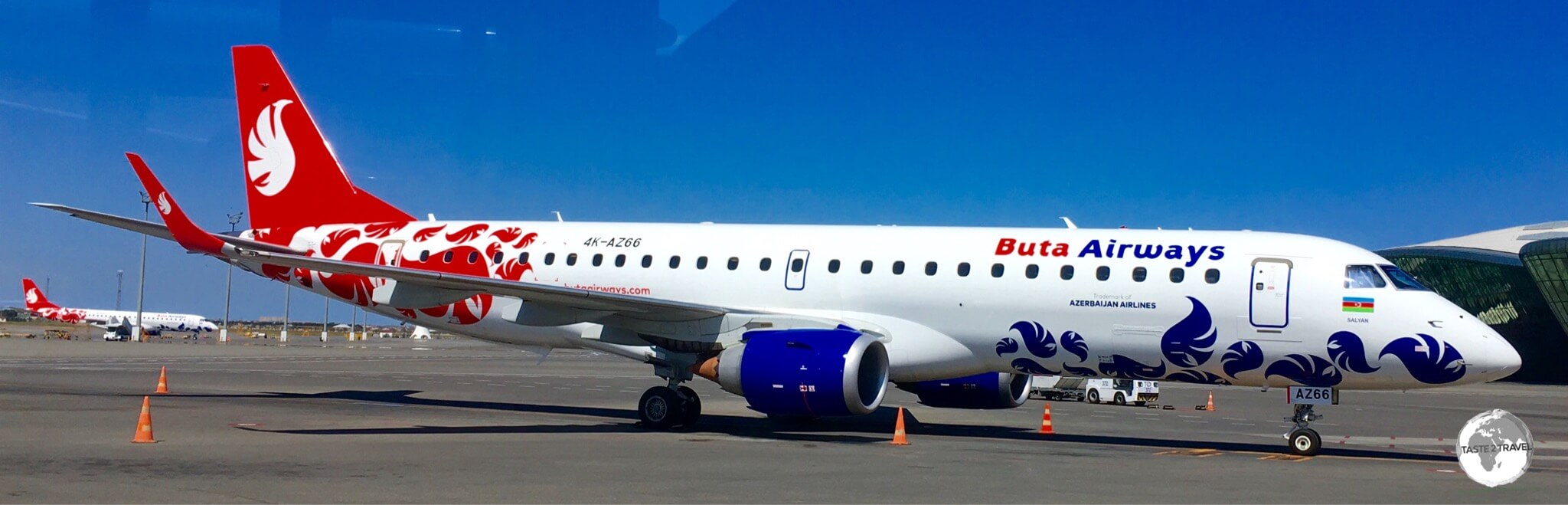
Air

The modern, futuristic, terminal 1 at Heydar Aliyev International Airport was designed by British architecture firm <i>Arup.</i>

The modern, futuristic, terminal 1 at Heydar Aliyev International Airport was designed by British architecture firm Arup.

The main international gateway to Azerbaijan is the modern Heydar Aliyev International Airport in Baku.

The airport consists of two terminals:

  • Terminal 1: International flights
  • Terminal 2: Domestic flights.

The modern and spacious Terminal 1 features a futuristic, human-centric design by architecture firm Arup with interiors by the Turkish studio Autoban.

The airport is located 20 kilometres northeast of Baku, and is connected to the city by a modern, fast highway.

Renowned for its iconic wooden "cocoons", the new Baku terminal replaces cold, industrial airport aesthetics with a warm, luxurious, and organic environment.

Renowned for its iconic wooden “cocoons”, the new Baku terminal replaces cold, industrial airport aesthetics with a warm, luxurious, and organic environment.

The focal point of the terminal interiror is a series of 16 custom-made, open-framework timber cocoons.

These protective, micro-architectural pods vary in size and house shops, cafes, private lounges, and children’s play areas.

The airport serves as the base for the national carrier, Azerbaijan Airlines.

The following airlines provide scheduled services to/ from Heydar Aliyev International Airport:

  • Air Arabia – flies to/ from Abu Dhabi, Sharjah
  • Air Astana – flies to/ from Almaty, Atyrau
  • Airblue – flies to/ from Lahore
  • Air Cairo – flies to/ from Sharm El Sheikh
  • Air Serbia – flies to/ from Belgrade
  • AJet – flies to/ from Ankara, Antalya, Istanbul–Sabiha Gökçen
  • arkia – flies to/ from Tel Aviv
  • Azerbaijan Airlines – flies to/ from Aktau, Almaty, Antalya, Astana, Baghdad, Bahrain, Barcelona, Batumi, Beijing–Capital, Berlin, Bishkek, Chișinău, Dammam, Delhi, Dubai–International, Dushanbe, Fuzuli, Geneva, Islamabad, Jeddah, Lahore, London–Gatwick, London–Heathrow, Malé, Milan–Malpensa, Minsk, Mumbai, Paris–Charles de Gaulle, Prague, Riyadh, Samarkand, Sharm El Sheikh, Symkent, Tabriz, Tashkent, Tbilisi, Tehran–Imam Khomeini, Tel Aviv, Trabzon, Urgench, Vienna
  • Centrum Air – flies to/ from Tashkent
  • China Southern Airlines – flies to/ from Guangzhou, Ürümqi
  • Fly Baghdad – flies to/ from Baghdad
  • FlyArystan – flies to/ from Aqtau
  • Flydubai – flies to/ from Dubai–International
  • FlyErbil – flies to/ from Erbil
  • FlyOne – flies to/ from Tashkent
  • Gulf Air – flies to/ from Bahrain
  • IndiGo Delhi
  • IrAero – flies to/ from Nizhnevartovsk, Orenburg, Perm
  • Iran Air – flies to/ from Tabriz, Tehran–Imam Khomeini
  • Iran Airtour – flies to/ from Tehran–Imam Khomeini
  • Iraqi Airways – flies to/ from Sulaymaniyah
  • Kuwait Airways – flies to/ from Kuwait City
  • LOT Polish Airlines – flies to/ from Warsaw–Chopin
  • Lutfhansa – flies to/ from Frankfurt
  • Pakistan International Airlines – flies to/ from Islamabad, Karachi, Lahore
  • Pegasus Airlines – flies to/ from Ankara, Antalya, Istanbul–Sabiha Gökçen, Izmir
  • Red Wings Airlines – flies to/ from Moscow-Zhukovsky, Yekaterinburg
  • S7 Airlines – flies to/ from Novosibirsk
  • Turkish Airlines – flies to/ from Istanbul
  • Uzbekistan Airways – flies to/ from Tashkent
  • Wizz Air – flies to/ from Budapest, Rome–Fiumicino

Airport Transport

Taxi: A regular metered Baku taxi to downtown will cost between 20-25 AZN with a journey time of 25-45 mins, depending on traffic – which is usually heavy.

The best taxi app to use in Azerbaijan is Bolt, with an average fare between the airport and downtown Baku costing around 15 AZN.

Bus: The public bus company, Baku Bus, operates an express airport shuttle (route H1), 24-hours a day, which departs every 30 minutes from 06:00 to midnight and every hour between midnight and 06:00. The shuttle runs between the airport and 28 May metro stop which is near the main railway station.

In order to use the bus, you’ll first need to purchase a stored-value BakuCard from the kiosk in the arrivals hall, as you cannot buy tickets on the bus. A single ride on the bus costs 1.30 AZN (USD$0.75) plus 2 AZN for the card, which is non-refundable.

Land


Important:

Currently (2026), you are unable to enter Azerbaijan by any land crossing.

At the time of the Covid-19 pandemic in 2020, a travel ban was enacted which prohibited anyone from entering Azerbaijan by land. 

This ban has remained in place ever since with authorities continuing to extend the ban.

However, it is possible to exit the country by land.  


Azerbaijan shares land borders wigth Georgia, Russia, Iran and Turkey.

A description of all land borders:

  • Georgia: situated to the west of Azerbaijan, shares a land border of 428 km (265 mi) which includes two international crossings.
  • Russia: situated to the north of Azerbaijan, shares a land border of 338 km (210 mi) which includes three international crossings and one crossing for locals only (Garax-Zukhul).
  • Iran: situated to the south of Azerbaijan, shares a land border of 1,132 km (703 mi) with Azerbaijan proper and 429 km (266 mi) with Nakhchivan. There is a total of two international crossings with Azerbaijan proper and one crossing with Nakhchivan at Culfa.
  • Turkey: shares a very short, 17 km (10 mi), border with Nakhchivan with one international crossing.

Rail

The historic Baku Central Train Station.

The historic Baku Central Train Station.

Azerbaijan is connected by rail to Russia, Georgia and Ukraine (via Russia).

There’s a rail connection with Armenia but this is presently closed.

The governments of Iran and Azerbaijan are currently working on connecting the two countries by rail.

There was a rail service which connected Nakhchivan with Iran, but this has been terminated.

The interior of the glitzy and sparkling clean main hall of Baku Central Station.

The interior of the glitzy and sparkling clean main hall of Baku Central Station.

Tickets for international trains departing from Baku station can be purchased from the international ticket desk at the main station.

The following International services depart from Baku station:

  • Russia: Train #55 leaves Baku every Thursday at 01:30 for the 53-hour odyssey north to MoscowKursky, arriving two days later at 03:20 in the morning. The cheapest online ticket on this service costs 183 AZN (USD$107).
  • Georgia: Train #38 departs Baku each evening at 20:40, arriving in Tbilisi the following morning at 08:55, a journey of 12 hours. If you wish to do the same journey in 8 hours, you should take a shared taxi (see the ‘Shared Taxi‘ section below for more details). The cheapest online ticket on this service costs 24 AZN (USD$14).
  • Ukraine: Azerbaijan Railways operate a train once a week to Kiev, departing Baku on Thursdays at 01:35, and arriving in Kiev on Monday at 11:46. On the same day, at 14:37, the train returns to Baku, arriving on Thursday at 04:10. The train passes through Russian territory between Azerbaijan and Ukraine, so you should ensure you have a Russian visa if required.

Bus

International buses depart from the Baku International Bus Station, which is known as the Avtovaghzal, serving destinations in Turkey, Georgia and Russia.

There are no direct buses from Baku to Iran, but you can take buses from Astara (on the Iranian side of the border) to Tehran.

Sea

Cargo boats, which also carry paying passengers, depart on an irregular basis from Baku International port, which is located at Alat, 80 km south of Baku.

Boats sail across the Caspian sea to the Kazakhstan port city of Kuryk (30 hours), which is located 70 km south of the city of Aktau. Beds in a 2-bed cabin cost US$80 per person or US$70 in a 4-bed cabin.

Getting Around

Baku Metro

Baku Metro Map

Baku Metro Map

The efficient and punctual Baku metro is the best way to travel around the capital. In order to use the system, you’ll need to pre-purchase a stored value BakuCard.

The system has 36 kilometres (22.76 mi) of track, with three lines serving 25 stations.

A Baku metro train.

A Baku metro train.

Opened in 1967, during the days of the Soviet Union, the metro is typical of other metros built in the former USSR, with deep central stations and exquisite decorations.

Tile mosaics, Nizami Metro Station, Baku.

Tile mosaics line the walls of Nizami Metro Station.

One of the most beautiful stations on the system is Nizami metro station, which is named after the great Azerbaijani poet and philosopher Nizami Ganjavi.

The station is decorated with mosaic panels which feature subjects from his works.

Public Buses

Buses, which are operated by Baku bus, are the most used form of public transport in the capital.

In order to ride any of the buses, you’ll first need to purchase a stored-value BakuCard which costs 2 AZN (USD$1.17), which is non-refundable.

A single journey costs 0.30 AZN (USD$0.17).

Inter-city buses depart from the Baku International Bus station, which is known as the Avtovaghzal.

If you don’t wish to wait for a bus, you’ll find plenty of, faster, shared taxis at the entrance to the station.

Taxi

Known locally as 'Eggplants', the streets of Baku are home to a fleet of London taxis which are all painted in 'Eggplant' purple.

Known locally as ‘Eggplants’, the streets of Baku are home to a fleet of London taxis which are all painted in ‘Eggplant’ purple.

If you’re a Londoner feeling homesick in Baku, you only need to hail a cab!

The Baku Taxi fleet is comprised of Eggplant-coloured London cabs (and also kethcup-red) which were originally ordered by the government when the country hosted the Euro-vision song contest in 2012.

The colour choice apparently came direct from the president and the cabs are commonly referred to as ‘eggplants’ by the locals.

A London taxi in Baku, where they are branded as "Baku Taxi".

A London taxi in Baku, where they are branded as “Baku Taxi”.

The initial order was for 1000 cabs, which were to replace an ageing fleet of Lada taxis, but this number has since grown, with ‘eggplants’ now whizzing everywhere around the capital.

Unlike their London counterparts, Baku Taxis can be hired for off-road adventures.

Unlike their London counterparts, Baku Taxis can be hired for off-road adventures.

While London taxis would never dare venture off-road, I saw at least one Baku taxi driving customers along the remote and rough, gravel road to the Mud Volcanoes, which are located 50 km south of the capital.

Shared Taxis

If you don’t have your own transport, the fastest and most convenient way to travel around Azerbaijan is with a shared taxi.

If you’re travelling to any of the borders, shared taxis are the way to go.

Taxis leave frequently, once all places have been filled, from outside the International Bus station in Baku.

Drivers will often inflate prices for tourists (or encourage you to take a private hire by purchasing all 4 places) so it’s best to confirm the correct price in advance from someone other than the driver.

Shared taxi rates are very reasonable with the six-hour journey from Baku to the Georgian border (“Red Bridge” border crossing) costing me 40 AZN (USD$23).

The one-hour taxi ride from the Georgian side of the border into Tbilisi cost me US$20 for a private hire.

I completed the 570 km journey from Baku to Tbilisi in 8 hours (which included an hour at the border).

Rental Car


And the award for “Most Speed Cameras in the world” goes to…. Azerbaijan!

While other countries (e.g. Brazil) are much larger than Azerbaijan and have way more cameras – for a small country, Azerbaijan is swamped with speed cameras.

I would estimate that, based on per kilometre travelled, Azerbaijan has more speed cameras than any other country in the world – they are everywhere.

As the government builds newer, faster highways, it is also installing speed cameras, on average, every 2 km, although sometimes they are just 1 km apart. Often you can see from one camera to the next!

The cameras are installed so that they are focused on the road immediately in front of the camera – rather than a longer field of focus.

This has led to locals adopting a driving rhythm of speeding up between cameras then slowing down.

Most cameras are mounted on a high stand in the middle of the highway, so they are easy to spot in advance.

It’s fair to assume that, if you spend any amount of time driving on the highways of Azerbaijan, you will be photographed.


Azerbaijan Travel Guide: Rental Car, Azerbaijan.

Off-roading in my rental car in Azerbaijan.

I am a fan of rental cars! They allow you to maximise and prioritise your time in a country. I rented a car through Hertz Baku, which cost me USD$28 per day.

I would highly recommend Hertz who allow you to pick up and return their cars at any of their three locations in Baku, without incurring any silly ‘one-way rental’ fees.

Azerbaijan License Plate.

The license plate on my rental car.

The government is currently busy, spending some of their oil revenue, on building excellent 4-lane highways throughout the country so journey times are being reduced, however many regions are still a long way from seeing any of the new infrastructure.


That’s the end of my Azerbaijan Travel Guide.

If you wish to leave any comments/ feedback, you can do so using the form below.

Safe Travels!
Darren


Further Reading

Other travel reports from the Central Asia region: